No Post-Launch Iteration: The Silent Reason Your AI Agents Stop Improving
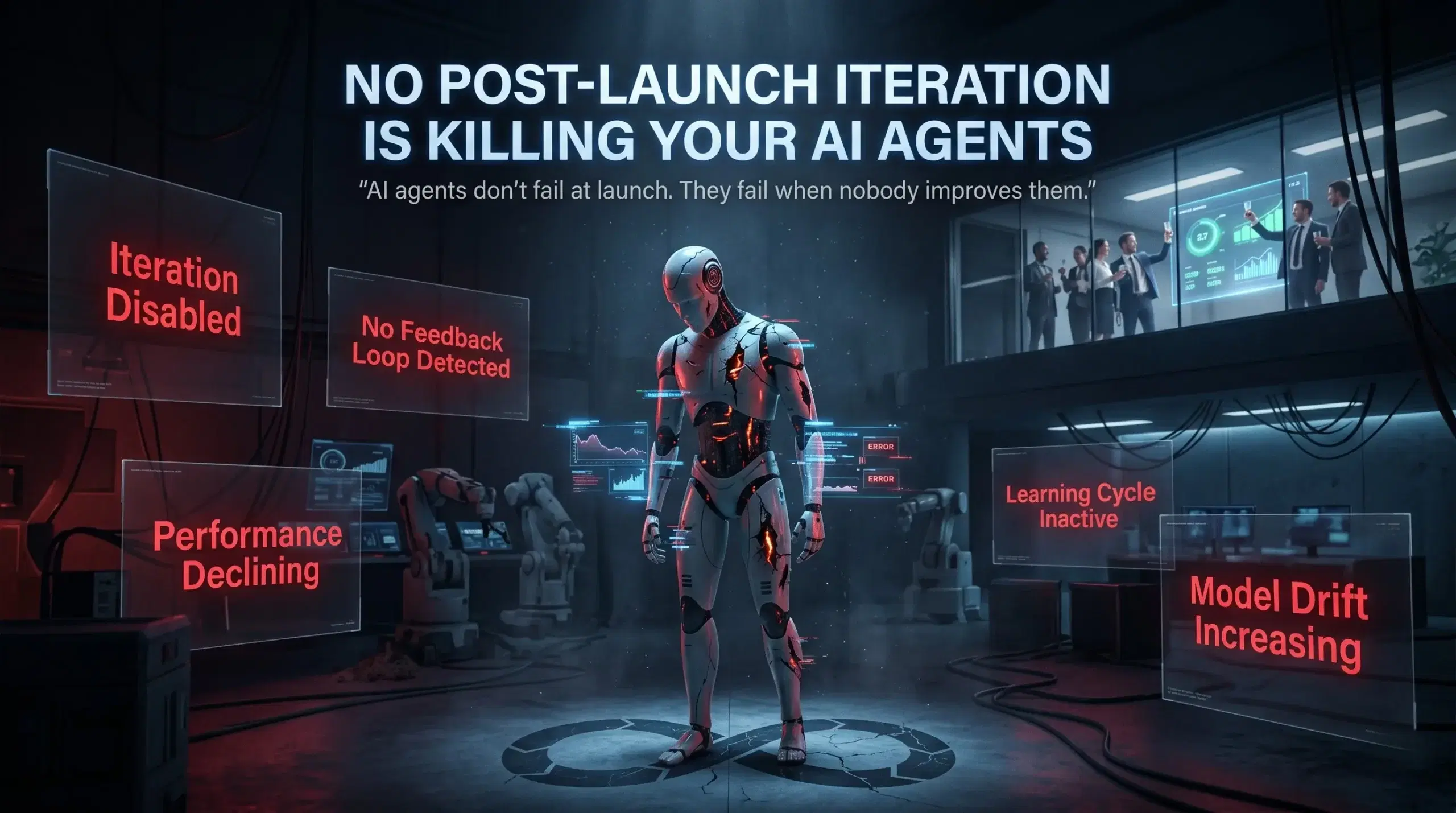
You spent months building your AI agent. The demo worked beautifully. Leadership approved the rollout. And then you launched. That was six months ago. Here is the question nobody in your organization is asking: is that agent actually getting better?
Most of the time, the honest answer is no. Not because the technology failed, but because the team moved on. There is a deeply ingrained assumption in enterprise AI deployments that launch is the finish line. It is not. Launch is where the real work begins. And skipping the post-launch iteration phase is one of the most expensive mistakes organizations make with AI agents today.
This is part of a broader pattern we have been tracking across enterprise AI readiness. If you have already read about how scattered knowledge silently sabotages your AI agents, you will recognize the theme: the problems that kill AI agent performance are rarely about the model itself. They are, instead, about the organizational infrastructure around it. And no post-launch iteration is one of the most overlooked gaps of all.
The Production Reality
The Composio AI Agent Report 2025 found that 67% of organizations report measurable gains from agent pilots, yet only 10% successfully scale to production. The gap does not sit in the technology. It lives, instead, in what happens, or more accurately what does not happen, after the agent goes live.
What No Post-Launch Iteration Actually Means for Your AI Agents
Let us be clear about what we are talking about. Post-launch iteration for AI agents is the ongoing process of monitoring real-world performance, collecting feedback, identifying failure patterns, and making targeted improvements. In other words, it is the cycle that turns a static deployment into a system that learns and compounds value over time.
Without it, your AI agent becomes frozen at the capability level it had on launch day. That is a serious problem, because the world around it does not stay frozen. Business processes shift, data patterns change, user needs evolve, and edge cases multiply. As a result, what performed well in testing starts encountering situations it was never prepared for in production.
The degradation is rarely dramatic, which is precisely what makes it so dangerous. A real-world case documented by SaaStr describes a team that deployed an AI agent, watched it perform well, and then moved on to other projects. Four months later, the agent had quietly stopped ingesting new data. Moreover, it kept running and kept producing outputs that looked plausible, but was operating entirely on stale information. The team only caught it when results started feeling slightly off. Not wrong enough to trigger alarms. Just a little out of step with reality.
This is the operational signature of an AI agent with no iteration loop. Rather than crashing visibly, it just slowly stops being useful.
Furthermore, the same dynamic is explored in depth in our LinkedIn article on why post-launch iteration is the silent reason your AI agents underperform, which looks at how this pattern shows up across enterprise deployments of every size.
Why AI Agent Performance Stagnation Is Now a Business Risk
The scale of the problem is becoming impossible to ignore. According to a June 2025 Gartner press release, over 40% of agentic AI projects will be canceled by the end of 2027, with escalating costs, unclear business value, and inadequate risk controls as the primary reasons. What does inadequate risk control look like in practice? Often it looks exactly like an agent running in production with no feedback loop and no mechanism for improvement.
McKinsey’s 2025 State of AI report reinforces the picture: fewer than 20% of AI pilots scale to production within 18 months, and only 39% of organizations report any enterprise-level EBIT impact from AI. Consequently, the organizations that are generating real returns are not necessarily the ones with the best models. They are the ones that have built processes for continuous improvement after launch.
Beyond that, research from Lemma, a YCombinator F25 company building continuous learning infrastructure for AI agents, found that agent performance can drop approximately 40% within weeks of deployment. This happens as real-world input drift introduces user behaviors and edge cases that were not present in testing. That is not a model failure. That is a process failure, and it is entirely preventable with the right iteration infrastructure in place.
The Compounding Cost
High-volume agents processing thousands of transactions daily see measurable accuracy improvements within 30 to 45 days when a feedback loop is active. Without one, however, performance flatlines or silently degrades from day one. The longer you wait to implement iteration, the more ground you have to recover.
The Five Ways No Post-Launch Iteration Damages AI Agent Readiness
Understanding the specific mechanisms of performance stagnation helps you make the case internally for why iteration infrastructure is not optional. Here are the five most common patterns we see.
1. Distribution Shift Goes Undetected
Your agent was trained and tested on a specific snapshot of your business data. The moment it goes live, however, the real world starts diverging from that snapshot. New product lines, updated workflows, seasonal demand shifts, and new customer segments all push the agent away from its original frame of reference. Distribution shift is the technical term for this divergence, and without continuous monitoring, it remains invisible until the agent starts making decisions that feel wrong but are hard to explain.
The connection to your broader data environment is critical here. If your organization already struggles with multiple versions of truth creating conflicting data across systems, distribution shift compounds that problem at speed.
2. Edge Cases Accumulate Without Resolution
No pre-launch test suite captures every real-world scenario. Edge cases are inevitable, and therefore the question is not whether your agent will encounter them but whether your organization has a mechanism for identifying, analyzing, and resolving them. Without an iteration process, those edge cases pile up and are never addressed. Each one represents a user who received a wrong or unhelpful response. At scale, this erodes trust in ways that are very difficult to recover from.
3. Business Process Changes Outpace the Agent
Organizations are not static. Processes change, policies update, and teams restructure constantly. As a result, an AI agent trained on how your business operated six months ago becomes increasingly misaligned with how it operates today. This is especially dangerous when the agent is handling workflows that touch customers, finance, or compliance. We have covered the upstream version of this problem in our piece on undocumented workflows and AI automation failures. The same dynamic plays out post-launch when iteration is absent.
4. No Feedback Means No Learning Signal
Research from Dust’s continuous improvement framework is clear on this point: if there is no clear owner for an agent and no time allocated to iterate, agents simply do not improve. Feedback that is never collected cannot drive learning. In addition, many organizations have no structured process for gathering input from the people who interact with the agent every day, whether they are employees or customers.
Because of this, organizations that have no system for measuring AI agent performance after deployment are essentially operating blind. You cannot improve what you are not measuring.
5. Security and Compliance Drift
An agent that handled sensitive data appropriately at launch may not remain compliant as regulations evolve and your data environment changes. Security models built for static systems need regular review when applied to autonomous agents. This is not theoretical: the AI Incidents Database reports that AI-related incidents rose 21% from 2024 to 2025. Furthermore, many of those incidents involve agents that were operating outside their original governance parameters without anyone noticing.
For a detailed look at why security frameworks designed for human operators fail AI agents, our blog post on security models built only for humans creating AI agent vulnerabilities covers the specific gaps that post-launch monitoring needs to close.
How Post-Launch Iteration Actually Works in Practice
Here is the thing: building an iteration loop for your AI agent does not require a separate engineering team or a six-month project. It requires clarity about four things.
Continuous Monitoring with Automated Evaluation
You need a system that scores agent responses against accuracy, helpfulness, and task completion on an ongoing basis, not just in pre-launch testing. Leading evaluation frameworks now support LLM-as-a-judge scoring, where a secondary model reviews a sample of production outputs and generates quality scores. Performance is graphed over time, and alerts fire when quality degrades. As a result, you find out from a dashboard rather than from an angry user or a manager who noticed something felt off.
Structured Feedback Collection from Real Users
The people using your agent every day are your best source of iteration signal. Building a lightweight, structured mechanism for them to flag unhelpful or incorrect responses turns anecdotal frustration into actionable data. Fortunately, the feedback does not need to be complex. A simple thumbs-down with a category tag is enough to surface patterns.
Beyond flagging errors, your approval and review layer for AI outputs becomes a source of iteration data, not just a quality gate. Every human review generates a signal about where the agent’s judgment diverged from the expected outcome.
Targeted, Incremental Updates
The most common mistake in post-launch iteration is trying to overhaul the agent when a targeted edit would suffice. The Dust framework recommends starting with the top failure mode surfaced by your monitoring, making a surgical change to instructions, data sources, or parameters, testing with a small group, and then rolling out broadly. Small, targeted changes are easier to test and, equally important, easier to roll back if something breaks.
This is the iteration mentality that software engineering teams have applied for decades. AI agents deserve the same discipline. Ship, measure, learn, and improve. Then repeat.
Ownership and Accountability
No iteration loop survives without a named owner. Someone in your organization needs to be responsible for the agent’s ongoing performance, with time explicitly allocated to the iteration process. Without this structure, feedback goes nowhere and insights gather dust. This gap is directly linked to the leadership ownership gap that keeps AI agents underperforming across enterprises, a pattern our piece on leadership not driving AI adoption examines from the top down.
What Your AI Agent Ecosystem Looks Like Without Iteration
Let us paint the picture honestly. Six months after launch, an AI agent with no iteration process typically looks like this:
- Performance has plateaued or quietly declined from its peak at launch
- Users have developed workarounds for the edge cases the agent handles poorly
- Business process changes have introduced misalignments the agent has no way to know about
- The team that built the agent has moved on to the next project
- Nobody has a clear picture of what the agent is actually doing at scale
This is not a hypothetical. It is the operational reality for a significant portion of enterprise AI deployments today. The Composio 2025 report’s finding that only 10% of organizations successfully scale agent pilots to production reflects both a pre-launch problem and a post-launch one. Many organizations reach production and then fail to sustain it because there is no iteration infrastructure keeping the agent aligned with reality.
The data quality dimension makes this even more acute. If your agent is operating on real-time data access gaps that leave it working from outdated information, the absence of post-launch iteration means those gaps compound rather than get resolved. Consequently, the agent becomes increasingly disconnected from the current state of your business.
Building the Case for Post-Launch Iteration Internally
If you are a technology leader reading this, you likely already know the iteration gap exists in your organization. The challenge, however, is making the case for dedicated iteration resources in an environment where the initial deployment already consumed significant budget and attention.
Frame It as a Cost of Stagnation, Not a Cost of Iteration
Here is the framing that tends to land with business stakeholders. Your AI agent is a revenue or efficiency-linked system. Its current performance level represents a baseline, and therefore every week you do not iterate is a week you are leaving potential improvement on the table. Every edge case that accumulates represents a customer interaction or process step where the agent is actively failing. The cost of not iterating is not zero. It is the cumulative sum of all those missed improvements and unresolved failures.
Anchor to ROI Evidence
McKinsey data shows that organizations achieving real ROI from AI are not necessarily using better models. Instead, they are applying better operational discipline to the systems they have. The 5.8x ROI on AI investment within 14 months that McKinsey’s research documents is not achieved by deploying and forgetting. It is achieved by deploying, measuring, iterating, and compounding gains over time.
Include Documentation Teams in the Conversation
Beyond the commercial case, the technical teams building documentation for your agent also need to be part of this discussion. If your documentation does not reflect how AI agents actually make decisions in the field, iteration becomes much harder because you have no reliable baseline to measure against.
Practical Steps to Start Your Post-Launch Iteration Process Today
You do not need to wait for a perfect system. You need to start. Here is a practical sequence that works for organizations at every stage of AI maturity.
Step 1: Assign an Agent Owner
Name a single person responsible for the ongoing performance of each production AI agent. While this does not need to be a full-time role, it needs to be a named accountability. Without ownership, everything else in this list will fail to stick.
Step 2: Define Your Performance Baseline
Before you can track improvement, you need to know where you are starting. Pull your current task completion rates, user satisfaction signals, and error patterns. If you do not have this data yet, the first iteration sprint should focus on instrumentation: getting the logging and monitoring in place so you have something to measure against.
Step 3: Run a Weekly Feedback Review
Set a recurring thirty-minute review where the agent owner looks at the feedback and error data from the previous week. Identify the top failure pattern. Then make one targeted improvement, not a full rebuild. Test it, observe the impact, and repeat next week.
Step 4: Connect Your Iteration Loop to Your Data Infrastructure
The iteration process only works if the agent is operating on accurate, current data. If scattered knowledge across your organization is limiting what your AI agents can access, your iteration loop needs to include data quality improvements, not just prompt tuning.
Step 5: Make Iteration Part of Your AI Governance Framework
Finally, post-launch iteration should not be an informal practice that depends on individual initiative. It should be a documented process with scheduled reviews, defined metrics, and governance sign-off for significant changes. This is what turns a good AI deployment into a sustainable one.
The Real Question Is Not Whether to Iterate. It Is How Long You Can Afford Not To.
Here is a perspective shift worth sitting with. Every enterprise software system your organization depends on gets maintained, updated, and improved on a regular cycle. Nobody deploys a CRM or an ERP and then never touches it again. Yet that is exactly the treatment many organizations give their AI agents, and then they wonder why the results plateau.
AI agents are not set-and-forget tools. They are living systems that operate in changing environments and need ongoing attention to stay aligned with your business reality. Therefore, the organizations that will generate lasting ROI from AI are the ones building the discipline of continuous iteration into their deployment model from day one.
Gartner’s warning that over 40% of agentic AI projects will be canceled by end of 2027 is not a verdict on AI technology. Rather, it is a verdict on AI deployment practices. The technology works. The processes around it are, however, still catching up. Post-launch iteration is one of the places where closing that gap makes the most immediate difference.
If you are building AI agents at scale and want to make sure iteration is built into your readiness model from the ground up, connect with the Ysquare Technology team on LinkedIn to explore how we approach enterprise AI agent deployment with long-term performance in mind.
Frequently Asked Questions
1. What is post-launch iteration for AI agents?
Post-launch iteration is the ongoing process of monitoring, evaluating, and improving an AI agent after it has been deployed to production. It includes collecting user feedback, tracking performance metrics, identifying failure patterns, and making targeted updates to instructions, data sources, or system configuration. Without this process, an agent's performance stagnates or declines as the real-world environment evolves around it.
2. Why do AI agents fail after launch if they worked well in testing?
Testing environments are controlled snapshots of your business data and processes. Production environments, in contrast, are dynamic. Real users introduce edge cases that testing never anticipated, business processes change, and data patterns shift over time. Without a post-launch iteration process, these divergences accumulate and performance degrades. The agent does not break dramatically. Instead, it gradually becomes less accurate and less useful.
3. How quickly does AI agent performance degrade without iteration?
Research from AI deployment teams indicates that agent performance can drop by approximately 40% within weeks of launch when real-world input drift goes unaddressed. High-volume agents processing thousands of daily transactions, however, show measurable accuracy improvements within 30 to 45 days when a feedback loop is active. The degradation timeline ultimately depends on how much the production environment differs from the training and testing environment.
4. What is an AI agent feedback loop and how does it work?
An AI agent feedback loop is a structured system that captures production performance data, routes error signals back to the people responsible for the agent, and drives targeted improvements. A mature feedback loop has four stages: detect issues through automated monitoring, diagnose the root cause by analyzing logs and traces, fix through targeted updates to prompts or data sources, and then monitor to confirm the improvement held. The loop runs continuously rather than in periodic review cycles.
5. How do I measure AI agent performance after deployment?
Core post-deployment metrics include task completion rate, response accuracy scored by automated evaluation, user satisfaction signals such as thumbs-up or thumbs-down feedback, latency, token usage, and error rate. These metrics should be tracked over time so you can see performance trends and detect degradation before it becomes a significant problem. In addition, alerts should fire automatically when key metrics drop below defined thresholds.
6. What is distribution shift and why does it affect AI agents after launch?
Distribution shift occurs when the data patterns an AI agent encounters in production differ from the patterns it was trained and tested on. Business processes change, user behaviors evolve, new product categories emerge, and seasonal factors shift the composition of queries and inputs the agent receives. As a result, an agent operating under distribution shift makes increasingly misaligned decisions because its underlying assumptions no longer match reality.
7. How often should AI agents be updated after deployment?
There is no universal cadence that fits every agent, but leading practitioners recommend a weekly review of performance data and user feedback, with targeted updates made as issues are identified rather than on a rigid schedule. The key is making small, surgical changes rather than large-scale overhauls, and testing each change before rolling it out broadly. Furthermore, some organizations run a formal monthly iteration sprint in addition to their continuous monitoring process.
8. Who should own the post-launch iteration process for an AI agent?
Every production AI agent needs a named owner with explicit accountability for its ongoing performance. This is typically a product manager, operations lead, or AI program manager, depending on the agent's function and the organization's structure. Moreover, the owner needs allocated time for iteration work, access to performance data, and the authority to make updates. Without named ownership, feedback goes unaddressed and iteration never happens systematically.
9. Is no post-launch iteration a sign that an organization is not ready for AI agents?
Yes, the absence of a post-launch iteration process is one of the clearest signals that an organization has not yet built the operational infrastructure that enterprise AI agents require. Many organizations focus heavily on the pre-launch phase while treating deployment as the end rather than the beginning. In reality, AI agent readiness requires not just the ability to build and deploy an agent, but the operational capability to sustain and improve it over time.
10. What is the business impact of skipping AI agent iteration after launch?
The business impact compounds over time. In the short term, edge cases go unresolved and user trust erodes. In the medium term, the agent becomes misaligned with current business processes and data, increasing error rates. In the long term, the organization faces the choice of a costly rebuild or abandoning the investment entirely. Gartner predicts over 40% of agentic AI projects will be canceled by end of 2027, and poor post-launch practices are a significant contributing factor. Organizations with active iteration loops, by contrast, see compounding performance gains rather than stagnation.
No Post-Launch Iteration: The Silent Reason Your AI Agents Stop Improving
You spent months building your AI agent. The demo worked beautifully. Leadership approved the rollout. And then you launched. That was six months ago. Here is the question nobody in your organization is asking: is that agent actually getting better?
Most of the time, the honest answer is no. Not because the technology failed, but because the team moved on. There is a deeply ingrained assumption in enterprise AI deployments that launch is the finish line. It is not. Launch is where the real work begins. And skipping the post-launch iteration phase is one of the most expensive mistakes organizations make with AI agents today.
This is part of a broader pattern we have been tracking across enterprise AI readiness. If you have already read about how scattered knowledge silently sabotages your AI agents, you will recognize the theme: the problems that kill AI agent performance are rarely about the model itself. They are, instead, about the organizational infrastructure around it. And no post-launch iteration is one of the most overlooked gaps of all.
The Production Reality
The Composio AI Agent Report 2025 found that 67% of organizations report measurable gains from agent pilots, yet only 10% successfully scale to production. The gap does not sit in the technology. It lives, instead, in what happens, or more accurately what does not happen, after the agent goes live.
What No Post-Launch Iteration Actually Means for Your AI Agents
Let us be clear about what we are talking about. Post-launch iteration for AI agents is the ongoing process of monitoring real-world performance, collecting feedback, identifying failure patterns, and making targeted improvements. In other words, it is the cycle that turns a static deployment into a system that learns and compounds value over time.
Without it, your AI agent becomes frozen at the capability level it had on launch day. That is a serious problem, because the world around it does not stay frozen. Business processes shift, data patterns change, user needs evolve, and edge cases multiply. As a result, what performed well in testing starts encountering situations it was never prepared for in production.
The degradation is rarely dramatic, which is precisely what makes it so dangerous. A real-world case documented by SaaStr describes a team that deployed an AI agent, watched it perform well, and then moved on to other projects. Four months later, the agent had quietly stopped ingesting new data. Moreover, it kept running and kept producing outputs that looked plausible, but was operating entirely on stale information. The team only caught it when results started feeling slightly off. Not wrong enough to trigger alarms. Just a little out of step with reality.
This is the operational signature of an AI agent with no iteration loop. Rather than crashing visibly, it just slowly stops being useful.
Furthermore, the same dynamic is explored in depth in our LinkedIn article on why post-launch iteration is the silent reason your AI agents underperform, which looks at how this pattern shows up across enterprise deployments of every size.
Why AI Agent Performance Stagnation Is Now a Business Risk
The scale of the problem is becoming impossible to ignore. According to a June 2025 Gartner press release, over 40% of agentic AI projects will be canceled by the end of 2027, with escalating costs, unclear business value, and inadequate risk controls as the primary reasons. What does inadequate risk control look like in practice? Often it looks exactly like an agent running in production with no feedback loop and no mechanism for improvement.
McKinsey’s 2025 State of AI report reinforces the picture: fewer than 20% of AI pilots scale to production within 18 months, and only 39% of organizations report any enterprise-level EBIT impact from AI. Consequently, the organizations that are generating real returns are not necessarily the ones with the best models. They are the ones that have built processes for continuous improvement after launch.
Beyond that, research from Lemma, a YCombinator F25 company building continuous learning infrastructure for AI agents, found that agent performance can drop approximately 40% within weeks of deployment. This happens as real-world input drift introduces user behaviors and edge cases that were not present in testing. That is not a model failure. That is a process failure, and it is entirely preventable with the right iteration infrastructure in place.
The Compounding Cost
High-volume agents processing thousands of transactions daily see measurable accuracy improvements within 30 to 45 days when a feedback loop is active. Without one, however, performance flatlines or silently degrades from day one. The longer you wait to implement iteration, the more ground you have to recover.
The Five Ways No Post-Launch Iteration Damages AI Agent Readiness
Understanding the specific mechanisms of performance stagnation helps you make the case internally for why iteration infrastructure is not optional. Here are the five most common patterns we see.
1. Distribution Shift Goes Undetected
Your agent was trained and tested on a specific snapshot of your business data. The moment it goes live, however, the real world starts diverging from that snapshot. New product lines, updated workflows, seasonal demand shifts, and new customer segments all push the agent away from its original frame of reference. Distribution shift is the technical term for this divergence, and without continuous monitoring, it remains invisible until the agent starts making decisions that feel wrong but are hard to explain.
The connection to your broader data environment is critical here. If your organization already struggles with multiple versions of truth creating conflicting data across systems, distribution shift compounds that problem at speed.
2. Edge Cases Accumulate Without Resolution
No pre-launch test suite captures every real-world scenario. Edge cases are inevitable, and therefore the question is not whether your agent will encounter them but whether your organization has a mechanism for identifying, analyzing, and resolving them. Without an iteration process, those edge cases pile up and are never addressed. Each one represents a user who received a wrong or unhelpful response. At scale, this erodes trust in ways that are very difficult to recover from.
3. Business Process Changes Outpace the Agent
Organizations are not static. Processes change, policies update, and teams restructure constantly. As a result, an AI agent trained on how your business operated six months ago becomes increasingly misaligned with how it operates today. This is especially dangerous when the agent is handling workflows that touch customers, finance, or compliance. We have covered the upstream version of this problem in our piece on undocumented workflows and AI automation failures. The same dynamic plays out post-launch when iteration is absent.
4. No Feedback Means No Learning Signal
Research from Dust’s continuous improvement framework is clear on this point: if there is no clear owner for an agent and no time allocated to iterate, agents simply do not improve. Feedback that is never collected cannot drive learning. In addition, many organizations have no structured process for gathering input from the people who interact with the agent every day, whether they are employees or customers.
Because of this, organizations that have no system for measuring AI agent performance after deployment are essentially operating blind. You cannot improve what you are not measuring.
5. Security and Compliance Drift
An agent that handled sensitive data appropriately at launch may not remain compliant as regulations evolve and your data environment changes. Security models built for static systems need regular review when applied to autonomous agents. This is not theoretical: the AI Incidents Database reports that AI-related incidents rose 21% from 2024 to 2025. Furthermore, many of those incidents involve agents that were operating outside their original governance parameters without anyone noticing.
For a detailed look at why security frameworks designed for human operators fail AI agents, our blog post on security models built only for humans creating AI agent vulnerabilities covers the specific gaps that post-launch monitoring needs to close.
How Post-Launch Iteration Actually Works in Practice
Here is the thing: building an iteration loop for your AI agent does not require a separate engineering team or a six-month project. It requires clarity about four things.
Continuous Monitoring with Automated Evaluation
You need a system that scores agent responses against accuracy, helpfulness, and task completion on an ongoing basis, not just in pre-launch testing. Leading evaluation frameworks now support LLM-as-a-judge scoring, where a secondary model reviews a sample of production outputs and generates quality scores. Performance is graphed over time, and alerts fire when quality degrades. As a result, you find out from a dashboard rather than from an angry user or a manager who noticed something felt off.
Structured Feedback Collection from Real Users
The people using your agent every day are your best source of iteration signal. Building a lightweight, structured mechanism for them to flag unhelpful or incorrect responses turns anecdotal frustration into actionable data. Fortunately, the feedback does not need to be complex. A simple thumbs-down with a category tag is enough to surface patterns.
Beyond flagging errors, your approval and review layer for AI outputs becomes a source of iteration data, not just a quality gate. Every human review generates a signal about where the agent’s judgment diverged from the expected outcome.
Targeted, Incremental Updates
The most common mistake in post-launch iteration is trying to overhaul the agent when a targeted edit would suffice. The Dust framework recommends starting with the top failure mode surfaced by your monitoring, making a surgical change to instructions, data sources, or parameters, testing with a small group, and then rolling out broadly. Small, targeted changes are easier to test and, equally important, easier to roll back if something breaks.
This is the iteration mentality that software engineering teams have applied for decades. AI agents deserve the same discipline. Ship, measure, learn, and improve. Then repeat.
Ownership and Accountability
No iteration loop survives without a named owner. Someone in your organization needs to be responsible for the agent’s ongoing performance, with time explicitly allocated to the iteration process. Without this structure, feedback goes nowhere and insights gather dust. This gap is directly linked to the leadership ownership gap that keeps AI agents underperforming across enterprises, a pattern our piece on leadership not driving AI adoption examines from the top down.
What Your AI Agent Ecosystem Looks Like Without Iteration
Let us paint the picture honestly. Six months after launch, an AI agent with no iteration process typically looks like this:
- Performance has plateaued or quietly declined from its peak at launch
- Users have developed workarounds for the edge cases the agent handles poorly
- Business process changes have introduced misalignments the agent has no way to know about
- The team that built the agent has moved on to the next project
- Nobody has a clear picture of what the agent is actually doing at scale
This is not a hypothetical. It is the operational reality for a significant portion of enterprise AI deployments today. The Composio 2025 report’s finding that only 10% of organizations successfully scale agent pilots to production reflects both a pre-launch problem and a post-launch one. Many organizations reach production and then fail to sustain it because there is no iteration infrastructure keeping the agent aligned with reality.
The data quality dimension makes this even more acute. If your agent is operating on real-time data access gaps that leave it working from outdated information, the absence of post-launch iteration means those gaps compound rather than get resolved. Consequently, the agent becomes increasingly disconnected from the current state of your business.
Building the Case for Post-Launch Iteration Internally
If you are a technology leader reading this, you likely already know the iteration gap exists in your organization. The challenge, however, is making the case for dedicated iteration resources in an environment where the initial deployment already consumed significant budget and attention.
Frame It as a Cost of Stagnation, Not a Cost of Iteration
Here is the framing that tends to land with business stakeholders. Your AI agent is a revenue or efficiency-linked system. Its current performance level represents a baseline, and therefore every week you do not iterate is a week you are leaving potential improvement on the table. Every edge case that accumulates represents a customer interaction or process step where the agent is actively failing. The cost of not iterating is not zero. It is the cumulative sum of all those missed improvements and unresolved failures.
Anchor to ROI Evidence
McKinsey data shows that organizations achieving real ROI from AI are not necessarily using better models. Instead, they are applying better operational discipline to the systems they have. The 5.8x ROI on AI investment within 14 months that McKinsey’s research documents is not achieved by deploying and forgetting. It is achieved by deploying, measuring, iterating, and compounding gains over time.
Include Documentation Teams in the Conversation
Beyond the commercial case, the technical teams building documentation for your agent also need to be part of this discussion. If your documentation does not reflect how AI agents actually make decisions in the field, iteration becomes much harder because you have no reliable baseline to measure against.
Practical Steps to Start Your Post-Launch Iteration Process Today
You do not need to wait for a perfect system. You need to start. Here is a practical sequence that works for organizations at every stage of AI maturity.
Step 1: Assign an Agent Owner
Name a single person responsible for the ongoing performance of each production AI agent. While this does not need to be a full-time role, it needs to be a named accountability. Without ownership, everything else in this list will fail to stick.
Step 2: Define Your Performance Baseline
Before you can track improvement, you need to know where you are starting. Pull your current task completion rates, user satisfaction signals, and error patterns. If you do not have this data yet, the first iteration sprint should focus on instrumentation: getting the logging and monitoring in place so you have something to measure against.
Step 3: Run a Weekly Feedback Review
Set a recurring thirty-minute review where the agent owner looks at the feedback and error data from the previous week. Identify the top failure pattern. Then make one targeted improvement, not a full rebuild. Test it, observe the impact, and repeat next week.
Step 4: Connect Your Iteration Loop to Your Data Infrastructure
The iteration process only works if the agent is operating on accurate, current data. If scattered knowledge across your organization is limiting what your AI agents can access, your iteration loop needs to include data quality improvements, not just prompt tuning.
Step 5: Make Iteration Part of Your AI Governance Framework
Finally, post-launch iteration should not be an informal practice that depends on individual initiative. It should be a documented process with scheduled reviews, defined metrics, and governance sign-off for significant changes. This is what turns a good AI deployment into a sustainable one.
The Real Question Is Not Whether to Iterate. It Is How Long You Can Afford Not To.
Here is a perspective shift worth sitting with. Every enterprise software system your organization depends on gets maintained, updated, and improved on a regular cycle. Nobody deploys a CRM or an ERP and then never touches it again. Yet that is exactly the treatment many organizations give their AI agents, and then they wonder why the results plateau.
AI agents are not set-and-forget tools. They are living systems that operate in changing environments and need ongoing attention to stay aligned with your business reality. Therefore, the organizations that will generate lasting ROI from AI are the ones building the discipline of continuous iteration into their deployment model from day one.
Gartner’s warning that over 40% of agentic AI projects will be canceled by end of 2027 is not a verdict on AI technology. Rather, it is a verdict on AI deployment practices. The technology works. The processes around it are, however, still catching up. Post-launch iteration is one of the places where closing that gap makes the most immediate difference.
If you are building AI agents at scale and want to make sure iteration is built into your readiness model from the ground up, connect with the Ysquare Technology team on LinkedIn to explore how we approach enterprise AI agent deployment with long-term performance in mind.
Read More

Ysquare Technology
05/06/2026

Why Leadership Must Drive AI Agent Adoption Across the Organization
Here is a question worth sitting with: Your company just spent six figures on AI tools. Your IT team built the pilots. Your vendor gave three onboarding sessions. And yet, six months in, adoption across the organization is hovering somewhere between “low” and “invisible.”
Sound familiar?
This is not a technology problem. It is not a budget problem. And it is definitely not a problem your IT team can fix on their own.
When leadership isn’t driving AI adoption, everything else you do to push it forward is just noise. Teams take their cues from the top. If they don’t see their managers, directors, and executives actively using AI, talking about AI, and holding people accountable to AI outcomes, then AI becomes just another initiative that will quietly fade away after the next quarterly review.
The data backs this up. McKinsey’s 2025 Workplace AI report surveyed 3,613 employees and 238 C-level executives and found that employees are ready for AI, but leaders are not steering fast enough. The biggest barrier to success is leadership.
That is not a small finding. That is the finding. And if you’re a CEO, CTO, or senior business leader, this one is squarely on your desk.
Why Leadership Isn’t Driving AI Adoption Is the Real Bottleneck
Most organizations frame AI adoption as a rollout problem. They build a roadmap, pick a vendor, set up training sessions, and wait for adoption to happen. It doesn’t. Because adoption isn’t a rollout problem. It’s a culture problem, and culture is set by leaders.
Think about how any new behavior spreads inside a company. People don’t change how they work because they attended a webinar. They change because they see their peers doing things differently, because their manager asks them different questions, and because their performance is measured against different outcomes. None of that happens without leadership actively driving it.
When executives treat AI as someone else’s responsibility, a few predictable things occur. Teams see AI as optional. Middle managers don’t prioritize it. Budgets get questioned at renewal time. And the early adopters who were genuinely excited burn out trying to evangelize uphill without any support.
McKinsey’s research shows that AI high performers are three times more likely to have senior leaders who demonstrate ownership of and commitment to their AI initiatives. Those same leaders actively use AI themselves and role-model the behavior they want to see across the organization.
That three-times multiplier isn’t marginal. It’s the difference between companies that are genuinely transforming and companies that are running expensive pilots forever.
What the Numbers Actually Say About Leadership and AI Success

The statistics here are sobering, and leaders need to face them honestly.
According to McKinsey’s 2025 State of AI report, 88% of organizations reported regular AI use in at least one business function in 2025, compared with 78% a year earlier. But only about one-third have begun scaling AI programs across the organization. The gap between “we’re using AI somewhere” and “AI is changing how we operate” is enormous, and leadership behavior sits right in the middle of it.
A 2025 report from WRITER, which surveyed 1,600 knowledge workers including 800 C-suite executives, found that more than one in three executives describe their generative AI adoption as a “massive disappointment.” Two-thirds of C-suite leaders reported tension between IT teams and other business units around AI implementation.
Here’s the number that should alarm every board room: Only 28% of organizations report that their CEO takes direct responsibility for AI governance and oversight. Yet the companies where the CEO is directly involved in AI governance report meaningfully higher business impact from their AI investments.
The math is simple. When the CEO owns it, it gets resourced, prioritized, and measured. When AI is delegated to a single team, it gets stuck.
McKinsey’s March 2025 report, “How Organizations Are Rewiring to Capture Value,” reinforces this directly: only 28% of respondents whose organizations use AI say their CEO oversees AI governance, and CEO oversight is strongly correlated with higher self-reported bottom-line impact.
The IBM Watson Story: A Masterclass in What Happens Without Real Governance
No case study on AI adoption failure is more instructive than the story of IBM Watson for Oncology.
IBM positioned Watson Health as a moonshot. The technology would democratize elite oncology expertise, helping clinicians around the world make better cancer treatment decisions. IBM committed billions of dollars. The marketing was confident. The promise was enormous.
What actually happened was a governance and leadership failure at scale.
The system was developed with training data curated by a small group of physicians using hypothetical patient cases, not real clinical data. When hospitals tried to deploy it in the real world, the recommendations were often inconsistent with national treatment guidelines. One physician at a Florida hospital told IBM executives the system was “worthless” for most cases, and that the hospital had bought it largely for marketing purposes.
When MD Anderson Cancer Center, one of Watson’s most prominent partners, transitioned from its legacy EHR system to Epic Systems, Watson couldn’t access live patient data. A $62 million investment became, in the words of one review, a “custom demo.”
By 2022, IBM announced the sale of Watson Health’s healthcare data and analytics assets to Francisco Partners. Financial terms were not officially disclosed, though reports placed the deal at more than $1 billion, a figure widely understood to represent a fraction of the total capital invested in acquisitions, development, and deployment across the life of the program.
The core failure wasn’t the technology itself. As researchers and analysts have since noted, the problem was structural and organizational. IBM’s leadership scaled the product before the conditions for it to work were established. There was no rigorous governance to catch the gap between what was being promised externally and what was actually possible internally. Clinical experts weren’t embedded deeply enough. The business case was built on narrative rather than evidence.
This is precisely what happens when AI adoption is treated as a product launch rather than as an organization-wide capability change that requires sustained leadership ownership at every level.
Source: Henrico Dolfing Case Study Analysis, December 2024
What Leaders Actually Need to Do Differently
The answer to “leadership isn’t driving AI adoption” isn’t to send another memo or mandate a new tool. It is to change behavior, specifically leadership behavior, in visible and consistent ways.
Here’s what that looks like in practice.
Use the tools publicly. When a CEO shares that they used AI to prepare for a board meeting, or a VP mentions in a team call that they ran a prompt to summarize competitive research, those small moments signal that AI is real, not aspirational. Visibility matters enormously.
Ask AI-related questions in reviews. If the only metrics being reviewed are the same ones from two years ago, nothing changes. Leaders who ask “how did we use AI to get this result?” or “where did AI save us time this quarter?” are reshaping what the team pays attention to.
Assign explicit ownership. Not a committee. Not a shared responsibility. One named person whose job includes making AI adoption work, with a budget, a timeline, and reporting lines directly into leadership. As our analysis of why leadership must drive AI agent adoption shows, the moment there is no single owner, accountability evaporates.
Remove the barriers teams face. Most frontline employees aren’t anti-AI. They’re time-poor, risk-averse, and waiting for permission. Leaders need to create psychological safety around experimentation, reduce the bureaucratic friction around tool access, and make it easy to try things without fear of looking incompetent.
Tie AI outcomes to performance conversations. What gets measured gets done. When teams know that AI capability building is part of how they are evaluated, they prioritize it.
The Readiness Problem Leaders Keep Ignoring
Leadership behavior is only one part of the equation. Even the most committed executive can’t drive adoption if the organization’s infrastructure isn’t ready for AI agents to work.
This is a critical point that gets skipped in most leadership conversations about AI.
Your AI agents are only as reliable as the data and systems they operate in. If knowledge is scattered across tools and teams, agents won’t find what they need. We cover this challenge in depth in our piece on why scattered knowledge is silently sabotaging your AI, and in our blog on scattered knowledge and AI agent readiness.
If your documented processes don’t reflect how work actually happens, agents will make decisions based on outdated or wrong information. This is explored in our piece on what happens when your documentation lies, and in our undocumented workflows blog.
If different teams are working from different versions of the same data, the conflict kills AI decision quality before it even starts. Our article on multiple versions of truth and why conflicting data kills your AI makes this concrete, and our blog on multiple versions of truth walks through the fix.
If agents can’t access real-time data, every decision they make is already stale. We break this down in why real-time data access is the hidden reason your AI agents stall and in our blog on AI agents failing without real-time data access.
And if there are no approval or review layers, no metrics for performance, and security systems that were designed for humans rather than autonomous agents, you’re not just slowing adoption down. You’re creating risk. These exact gaps are covered in our deep dives on AI agents with no approval or review layer, security built only for humans, and no metrics for AI performance.
Leaders who genuinely want to drive AI adoption have to ask: are we actually ready for agents to operate here? Or are we trying to drive on a road that hasn’t been built yet?
The Leadership Gap vs. The Readiness Gap: A Practical Framework
Understanding both gaps helps you prioritize the right interventions. Here is a simple way to think about where your organization stands.
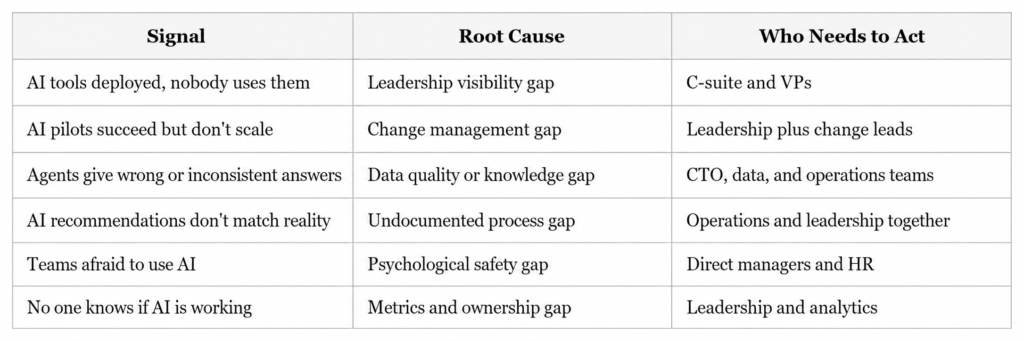
Most organizations have problems in multiple columns at once. The common thread is that none of these get fixed without leadership actively identifying the problem, naming it publicly, and committing resources to solve it.
Three Questions Every Leadership Team Should Answer This Quarter
If you’re serious about closing the gap between “we have AI” and “AI is working for us,” start with these three questions in your next leadership session.
One: Where is AI visibly showing up in our leadership behavior? Not in slides. In actual day-to-day decisions, communications, and reviews. If the honest answer is “not really anywhere,” that’s where to start.
Two: Who owns AI outcomes across this organization? Not IT. Not a vendor. A named individual with authority, accountability, and a direct line to leadership. If you can’t answer this in thirty seconds, ownership doesn’t exist.
Three: What does success look like in ninety days? Not annual ROI projections. A concrete, measurable outcome that proves the investment is moving in the right direction. If there’s no near-term success metric, there’s no accountability loop.
These aren’t complicated questions. But they require an honest conversation that many leadership teams keep avoiding because they’re busy and because the status quo feels comfortable.
The status quo, meanwhile, is getting more expensive every quarter.
What High-Performing Organizations Do Differently
McKinsey’s research identifies a consistent pattern among AI high performers. They’re not necessarily the companies with the biggest budgets or the most sophisticated technology. They’re the companies where senior leaders demonstrate visible ownership of AI initiatives, actively use AI themselves, and role-model the adoption behavior they want to see.
These organizations treat AI not as an IT capability but as a business capability. The difference in framing changes everything: who owns it, how it’s resourced, how progress is measured, and how it’s talked about internally.
They also do something that most organizations skip. They redesign workflows rather than bolting AI onto existing ones. Leaders at these companies are willing to ask harder questions about how work actually flows, where decisions get made, and what needs to change structurally for AI to deliver real value.
That kind of organizational introspection doesn’t happen at the team level. It requires leadership to drive it.
Conclusion: Adoption Starts at the Top, Not at the Tool
There’s a version of this story that ends well, and a version that doesn’t. The difference isn’t the quality of the AI tools, the size of the implementation budget, or the enthusiasm of the early adopters.
The difference is whether your leaders treat AI as someone else’s problem or as their own.
When leadership isn’t driving AI adoption, you get pilots without scale, investments without returns, and teams that quietly go back to doing things the way they always have. When leadership does drive it, you get the 3x performance multiplier McKinsey observed. You get teams that feel permission and urgency to change. You get an organization that actually transforms.
The infographic above puts it plainly: “If leaders don’t actively use AI, teams won’t prioritize it. Adoption starts at the top.” That’s not a motivational phrase. That is an operational truth backed by the data.
Your next move is not another pilot. It’s a leadership conversation about ownership, visibility, and accountability. Start there, and everything else becomes easier.
Ready to Assess Your AI Agent Readiness?
At Ysquare Technology, we help enterprise and growth-stage companies identify exactly where their AI adoption is breaking down and what leadership, data, and infrastructure changes are needed to fix it.
If your AI investments aren’t delivering what you expected, the problem is almost certainly upstream of the technology. Let’s find it together.
Connect with us on LinkedIn or visit www.ysquaretechnology.com to start the conversation.
Read More
Ysquare Technology
01/06/2026

AI Performance Metrics: Why Your AI Is Losing Money
Most leaders think deploying AI is the hard part. It is not. Running AI without any way to measure whether it is actually working, that is the hard part. And right now, a startling number of organizations are doing exactly that.
Here is what most people miss: deploying an AI agent without performance metrics is not neutral. It is a slow bleed. Every day the system runs without measurement, errors go undetected, costs drift upward, and the gap between what you expected and what you are getting quietly widens. By the time someone notices, the damage is already embedded in your operations.
This article is for CEOs, CTOs, and technology leaders who are serious about getting real business value from AI, not just deploying it and hoping for the best. If your AI agents are live but you cannot answer the question “Is this working and how do we know?”, keep reading. We are going to change that.
Why “No Metrics for AI Performance” Is Sign Number Eight on the AI Readiness Watchlist
When we talk about the 15 signs your organization is not ready for AI agents, the absence of AI performance metrics sits at number eight for a reason. It sits squarely in the middle because it is the hinge. Everything before it, from scattered knowledge and undocumented workflows to poor data quality and no approval layers, creates conditions where AI fails. But without measurement, you never know which of those failures is happening, or how badly.
The phrase “what gets measured gets optimized” sounds like a motivational poster. In AI operations, however, it is a survival principle. Without a measurement layer, your AI agent has no feedback mechanism. It cannot improve because nothing tells it, or you, when it is wrong. Mistakes that a human reviewer would catch in a traditional workflow scale silently through automated systems until they surface as a business problem rather than an AI problem.
This is the real danger. Not that your AI will fail dramatically on day one. But that it will fail quietly, incrementally, across thousands of interactions, and you will have no idea until the downstream consequences surface in your P&L, your customer satisfaction scores, or your compliance audit.
What the Data Actually Says About AI Measurement
The numbers here are genuinely alarming. Moreover, they deserve to be seen clearly rather than buried in footnotes.
McKinsey’s research confirms that fewer than 20% of organizations track well-defined KPIs for their GenAI solutions. That means more than four out of five organizations are running AI without a structured measurement framework. According to the same research, scaling AI without defined metrics is consistently cited as the primary reason AI programs stall out before they deliver value.
Gartner’s AI Maturity Survey found that only 63% of high-maturity organizations, the ones already considered advanced in AI adoption, run financial risk analysis, ROI analysis, and measure customer impact in any structured way. Think about what that means for organizations still in earlier stages of the journey.
Deloitte’s State of GenAI 2024 report found that 41% of business leaders openly admit they struggle to measure AI’s impact on their operations. IBM’s ROI of AI Report, conducted by Morning Consult, put the positive ROI figure at just 47%. More than half of companies investing in AI cannot confirm they are seeing returns.
McKinsey’s Superagency in the Workplace report found that 92% of companies plan to increase their AI investments over the next three years, while only 1% of leaders describe their companies as mature in AI deployment. The message is clear: AI investment is accelerating, but AI operating maturity is still far behind.
This is not an AI problem. It is a management problem. And it is one that can be fixed.
What “No AI Performance Metrics” Actually Looks Like Inside an Organization
It rarely looks like chaos. That is part of what makes it so hard to catch. Here is what it actually looks like day to day.
Your dashboards show activity, not outcomes. You can see how many tasks the AI agent processed, how many queries it responded to, how many workflows it touched. What the dashboard does not show is whether any of that activity produced a better result than what you had before. Volume is not value.
Improvement happens by accident when it happens at all. Without baselines and benchmarks, you have no way to distinguish a genuine performance gain from random variance. Your AI might get better over time, or it might quietly degrade. You will have no way to tell the difference until something breaks loudly enough to notice.
The AI team and the business team are measuring different things. Engineers track uptime, latency, and model accuracy. Business leaders track revenue, customer satisfaction, and operational costs. With no shared measurement framework, these two groups are essentially working on different problems and calling them the same project.
Errors compound before anyone catches them. This connects directly to the risk of running AI without an approval or review layer in your workflows. If you want to understand how unreviewed AI outputs scale into operational risk, the breakdown of what happens when no approval or review layer exists in your AI setup makes the connection concrete. Without metrics, you cannot see errors accumulating. Without a review layer, you cannot stop them from spreading.
The IBM and MD Anderson Case Study: A Sixty-Two-Million-Dollar Lesson in Missing Metrics
When people ask for a real-world example of what it costs to run AI without a clear measurement and validation framework, this is the one that belongs in every boardroom conversation.
IBM and MD Anderson Cancer Center partnered to build the Oncology Expert Advisor, a Watson-powered advisory tool designed to assist oncologists in clinical decision-making. The project was well-funded, medically ambitious, and backed by genuine intent to improve patient care. A prototype was tested in the leukemia department.
MD Anderson cancelled the project in 2016 after spending approximately sixty-two million dollars. As reported by IEEE Spectrum, the system never became a commercial product. The project ran into serious difficulties with the realities of clinical data, including the complexity of electronic health records, validation challenges, and the absence of clear performance checkpoints that would have allowed teams to catch integration problems early and course-correct before costs escalated.
The lesson is not that AI cannot work in healthcare. It absolutely can, and does. The lesson is that high-stakes AI needs clear success criteria, clinical validation standards, integration readiness checks, and measurable performance milestones before it moves toward production deployment. Without those checkpoints built in from the start, you have no mechanism to identify failure until the budget is already spent.
Source: IEEE Spectrum, “IBM Watson, Heal Thyself: How IBM Overpromised and Underdelivered on AI Health Care.”
The AI Performance Metrics That Actually Move the Needle
Here is where most measurement frameworks go wrong. They measure what is easy to pull from a system log rather than what tells you whether the AI is creating business value. Let us fix that.
Accuracy and Quality Metrics
First, you need to know whether the AI is producing correct, useful outputs. The most practical ones to track are task completion rate (did the agent finish what it was asked to do), recommendation acceptance rate (when the AI suggests something, how often do humans agree it was right), and error rate per thousand interactions. Furthermore, if your AI is producing outputs that humans routinely override or correct, that pattern is itself a critical data point.
Efficiency Metrics
Beyond accuracy, efficiency metrics connect AI activity directly to cost and speed. Compare average handling time before and after AI deployment on the same process. Track cost per task completed. Measure the ratio of AI-resolved interactions to human-escalated ones. As a result, you will know quickly whether the AI is automating volume while also increasing cost per unit, which happens more often than most leaders expect.
Business Impact Metrics
These are, ultimately, the ones that justify the budget conversation. How much revenue has AI-assisted decisions influenced? What has happened to customer satisfaction scores in workflows the AI now touches? Are operational costs in targeted areas trending down or up? In short, these metrics transform AI from an IT project into a business strategy.
Risk and Safety Metrics
Finally, risk and safety metrics are consistently the most overlooked category. Track the rate at which AI-generated outputs require human correction after the fact. Monitor escalation volumes for signals that the AI receives requests outside its reliable range. Run regular compliance checks on AI-involved decisions. These metrics are your early warning system, and without them, you are operating blind.
If your data quality is inconsistent across systems, all of these metrics will be unreliable at the source. This is why addressing multiple versions of truth in your data is not a separate workstream from building an AI measurement framework. They are the same problem looked at from two angles.
Why Most AI Measurement Frameworks Fail Before They Start
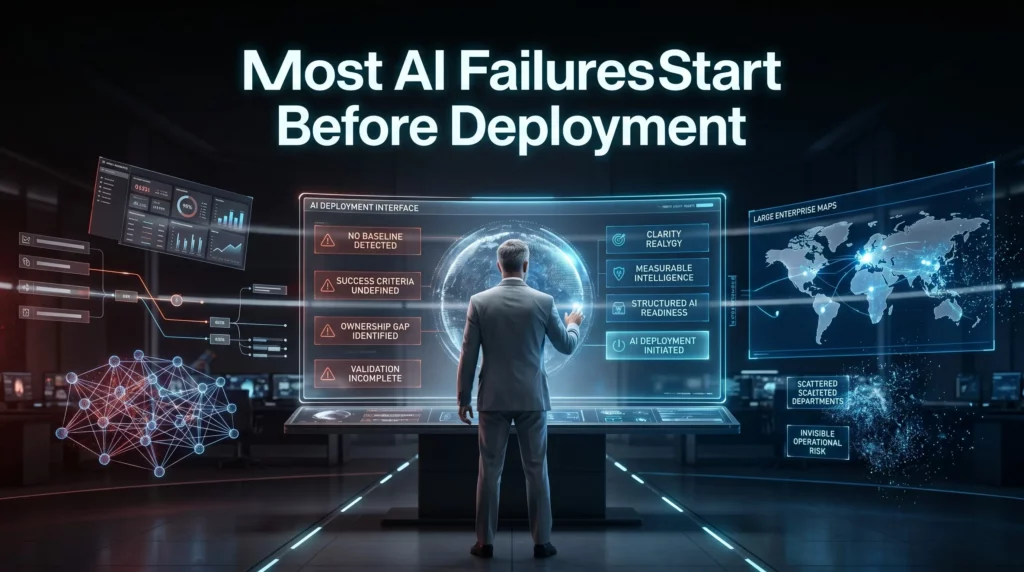
Here is the catch that most implementation guides skip over. Building a metrics framework after deployment is significantly harder than building it before. And most organizations try to do exactly that.
By the time you realize you need measurement, your AI has already been running for weeks or months. You have no baseline to compare against. The teams closest to the pre-AI process have moved on to other priorities. Moreover, real-world inputs have already shaped the AI’s behavior in ways that teams never benchmarked, so there is nothing meaningful to measure improvement against.
This is why the measurement conversation needs to happen before go-live, not after. When you design the AI agent’s workflow, that is when you define success. What does this agent need to accomplish for this deployment to be worthwhile? Write it down in specific, measurable terms. That sentence becomes your first performance metric.
The other failure pattern is assigning measurement responsibility to nobody in particular. Metrics without owners are decoration. Someone on your team needs to own each KPI, report on it regularly, and have the authority to escalate when it moves in the wrong direction. If measurement is everyone’s responsibility, it will quickly become no one’s.
This connects to a broader readiness challenge around ownership in AI programs. The same dynamic that creates problems when no one owns AI outcomes at the strategic level plays out identically at the metrics level. Accountability has to be assigned, not assumed.
How to Build a Practical AI Performance Measurement Framework in Four Steps
You do not need a six-month consulting engagement to get started. Here is a practical sequence that works.
Step one: Define success before deployment. For each AI agent or workflow, write one to three specific statements that describe what success looks like. Keep them concrete. For instance, “The AI will resolve 65% of Tier 1 support queries without human escalation” is a success statement. “The AI will help improve customer service” is not.
Step two: Establish your baseline. Pull the current performance data for the process your AI is replacing or augmenting. How long does it take? How accurate is it? What does it cost? How satisfied are customers with the outcome? That data is your starting point for every future comparison.
Step three: Build measurement into the rollout schedule. Do not treat monitoring as an afterthought. Therefore, schedule weekly check-ins in the first month, moving to monthly reviews as performance stabilizes. Make AI performance a standing agenda item in your technology and operations reviews.
Step four: Assign ownership and act on the data. Every metric needs a named owner. Every review needs to end with a decision, whether to stay the course, adjust the AI’s configuration, escalate a data quality issue, or retrain on new inputs. Consequently, measurement only creates value when it drives action.
If you are finding that your AI agents struggle because of data fragmented across systems, the underlying problem of scattered knowledge silently sabotaging your AI is worth addressing alongside your measurement buildout. Metrics built on fragmented data will give you fragmented insights.
The Leadership Reality Check
Let us be honest about something. Metrics programs do not fail because the metrics are wrong. They fail because leadership does not review them consistently enough to create accountability.
Gartner’s research found that only 27% of executives have a comprehensive AI strategy, and just 20% believe their workforce is actually ready for AI at scale. As a result, that gap in strategic preparedness shows up most visibly in measurement. When leadership is not looking at AI performance data, no one below them will treat it as a priority either.
If you are a CTO or CIO reading this, the most direct thing you can do to accelerate your AI measurement maturity is put AI performance metrics in your regular business reviews. Not as a technology report. As a business report. Accuracy rates, cost per task, escalation volumes, and business outcome trends sitting in the same review as revenue and customer satisfaction. That framing changes how every team in the building thinks about AI accountability.
In addition, if your AI agents operate without real-time data, the measurement challenge becomes even harder because your AI outputs outdated information before it ever reaches a decision-maker. The full picture of why AI agents fail without real-time data access is a related read that fills in this gap.
From Measurement to Continuous Improvement
The point of tracking AI performance metrics is not to generate reports. It is to create a closed loop where your AI system gets progressively better over time.
High-maturity AI organizations understand this well. Gartner’s research found that 45% of organizations with strong AI maturity keep their AI initiatives in production for three or more years, against just 20% of low-maturity organizations. The difference is almost never the sophistication of the initial model. Instead, it is whether the organization has the measurement and iteration infrastructure to keep improving after launch.
The loop looks like this: deploy with defined success criteria, measure against them, identify the gap between actual and target performance, adjust, and measure again. That cycle, repeated consistently, is what separates AI programs that deliver compounding value from those stuck permanently in pilot phase.
Without performance data, however, this loop cannot close. You cannot adjust what you cannot see. And if your documentation of how those workflows are supposed to run does not match how they actually run, your measurement baseline rests on false assumptions. The full picture of what happens when your documentation lies about how work actually gets done explains why this matters before you build any measurement framework.
The Connection Between Measurement and Every Other AI Readiness Challenge
Here is what most people miss when they think about AI performance metrics as a standalone issue. Measurement does not fix your AI readiness gaps in isolation. Rather, it makes every other gap visible.
Poor data quality shows up immediately in your accuracy metrics. They will start reflecting noise before you even realize the source of the problem. Beyond accuracy, if your AI agents are relying on conflicting data across multiple systems, inconsistent outputs will show up in your error rates as well. Processes buried in people’s heads rather than documented anywhere cause your AI’s task completion rate to plateau at a frustratingly low ceiling. Similarly, a security model built only for human users and not for autonomous agents will cause your risk metrics to flash warnings before your security team even identifies the source.
This is why measurement is the pivot point in the AI readiness journey. Not because it solves everything, but because it makes everything else solvable. You cannot fix what you cannot see. And right now, most organizations cannot see nearly enough.
The connection between real-time data access and measurement accuracy is also worth calling out explicitly. If your AI agents are acting on data that is hours or days out of date, the actions they take will look correct in the moment and incorrect in the outcome. Understanding why real-time data access is the hidden reason AI agents struggle will save you from building measurement frameworks on top of a stale data problem.
And if your workflows are undocumented and buried inside individual employees, your AI agent will hit invisible walls that your metrics will expose but that your team will struggle to diagnose without better process documentation.
Conclusion: The AI You Cannot Measure Is the AI You Cannot Trust
Here is the real shift in thinking we want to leave you with. Measurement is not a reporting function. It is a trust function.
You cannot trust an AI system you cannot measure. You cannot justify continued investment in something you cannot prove is working. And you cannot build organizational confidence in AI adoption when the people closest to the work have no visibility into whether the AI is helping or hurting.
The good news is that this is one of the most actionable AI readiness gaps on the list. You do not need a perfect framework on day one. You need clear success criteria, an honest baseline, a consistent review cadence, and named owners for each metric. Start there, and build from it.
At Ysquare Technology, we help organizations design and deploy AI agents with the measurement infrastructure built in from the start, not bolted on after the problems show up. If your AI is running without metrics, or your metrics are tracking the wrong things, we can help you build a framework that connects your AI performance directly to business outcomes.
Connect with us on Ysquare Technology’s LinkedIn page or visit ysquaretechnology.com to start the conversation. Your AI is either getting better every week or quietly drifting. Measurement is how you make sure you know which one is happening.
Read More
Ysquare Technology
25/05/2026