Human-in-the-Loop AI Agents: Why Enterprise Oversight Is Non-Negotiable
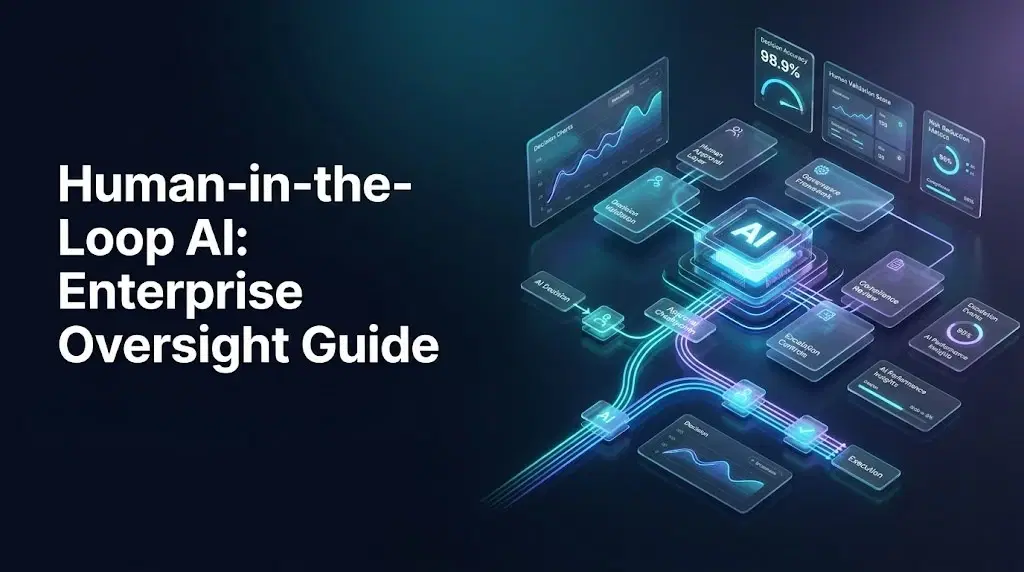
Here’s a question most leadership teams haven’t seriously answered yet: if your AI agent made a critical error right now, who would catch it — and how fast?
If the honest answer is “we’d probably find out eventually,” your organization has a Human-in-the-Loop (HITL) problem. And it’s one of the most expensive blind spots in enterprise AI today.
Think about this: an AI agent handling customer refunds quietly approves transactions that should have been escalated. No alert fires. No human checks in. Days pass. By the time someone notices, the same error has played out dozens of times. That’s not a technology failure — that’s a missing checkpoint.
This happens more often than people admit. The absence of human oversight in AI workflows isn’t usually a deliberate call. It’s a gradual erosion — one skipped review, one assumed safeguard, one process that “we’ll monitor later.” Leadership typically finds out only after a public incident or an operational blowup.
This post, part of our ongoing AI Agent Readiness Series, breaks down what human-in-the-loop AI actually means, what the data says about risk, and how to build real oversight into your AI agent workflows before something goes wrong.
What Human-in-the-Loop AI Actually Means (And What It Doesn’t)
Let’s be honest — “human-in-the-loop” has become one of those phrases people nod at without unpacking. So here’s what it actually means in the context of AI agents.
HITL is a deliberate system design where a real person reviews, approves, or can override an AI agent’s decision before it becomes irreversible — especially in high-stakes situations. It’s not checking a dashboard occasionally. It’s embedding human judgment at the specific points in a workflow where the cost of a wrong decision is too high to leave entirely to automation.
Without this, an agent that pulls incorrect data, sends the wrong email, or approves a flawed transaction will simply proceed. The damage happens before anyone looks at a log.
Here’s the catch: HITL isn’t a single switch you flip. It’s a series of strategic decision points woven through an agent’s workflow — from how it sources data, to what actions it’s allowed to take autonomously, to where it must stop and wait for a human call. Miss any of those points, and you’ve left a gap.
It’s closely related to the concept of an approval or review layer in AI systems, but goes further. An approval layer is procedural — it defines a step in the process. HITL is the human actually exercising judgment at that step. It also gives practical meaning to AI agent boundaries — because boundaries only work when someone is positioned to enforce them in real time.
The Real Cost of Running AI Agents Without Oversight
This isn’t a hypothetical risk. According to a 2026 study by IBM’s Institute for Business Value, conducted with Oxford Economics across 2,000 senior technology executives, organizations averaged 54 AI agent incidents in the past year that required human intervention to correct. Of those, 17% were classified as high-severity, taking over four hours to contain.
What happened during those high-severity incidents?
- 37% resulted in data exposure or security breaches
- 33% triggered cascading system failures
- 17% created compliance issues
And those are just the incidents that were documented.
The same IBM research found that two-thirds of CIOs and CTOs are now accountable for AI systems they don’t fully control. 70% said business units are deploying AI faster than IT can track. 77% reported that AI adoption is outpacing governance. Only 11% felt genuinely prepared for the scale of agent deployment coming in the next twelve months.
The real question is: what separates the organizations managing this well from those learning lessons the hard way? IBM’s analysis found that organizations embedding governance and control mechanisms directly into their AI systems experienced 25% fewer incidents than those relying on manual oversight after the fact. That gap tells you everything.
This connects directly to a broader vulnerability: security frameworks built only for human users. Traditional security assumes a person is behind every action. When an AI agent operates autonomously, that assumption breaks down — and HITL mechanisms are what re-establish meaningful control.
AI Leaders vs. Laggards: The Oversight Divide
McKinsey’s 2025 State of AI report, drawn from nearly 2,000 respondents across approximately 105 countries, found that 51% of organizations experienced at least one negative consequence from AI in the past year. Inaccuracy was the most common culprit, affecting 30% of respondents.
What most people miss in that stat is what it implies at scale. An error rate that seems manageable in a ten-transaction-a-day pilot becomes a genuine liability when the same agent processes tens of thousands. Inaccuracy doesn’t stay small — it scales with the agent.
Here’s the data point that matters most: high-performing organizations were significantly more likely to have defined HITL validation processes — 65% of them had one, compared to just 23% of other organizations. That’s not a minor gap. That’s the structural difference between companies that can safely scale AI and those that end up scaling their mistakes.
Part of why errors spread unchecked relates to data integrity. As explored in our coverage of multiple versions of truth in AI systems and the breakdown of conflicting data, a human reviewer is often the only barrier between a minor data conflict and a decision that affects a real customer. Without clear metrics for AI performance, most organizations won’t even know how often this is happening until a complaint or audit surfaces it.
Why Agentic AI Projects Collapse Without Human Checkpoints
Gartner’s June 2025 forecast delivers a blunt warning: more than 40% of agentic AI projects are predicted to be cancelled by the end of 2027. The primary reasons cited — escalating costs, unclear business value, and inadequate risk controls — aren’t technical failures. They’re governance failures.
Here’s how it typically plays out. Leadership approves an agentic AI budget based on promised efficiency gains. The agent goes live. Oversight is minimal. Errors accumulate quietly. Then the cost of correcting those errors starts appearing on the balance sheet — and suddenly the CFO is asking whether this was worth it. The project gets cancelled. Not because AI failed, but because the governance around it did.
Two factors consistently drive this pattern. First, when leadership isn’t actively engaged with AI adoption, the conversation about where human checkpoints should sit never gets escalated beyond the project team. Executives don’t know what to ask about, so they don’t ask.
Second, when there’s no clear ownership of AI systems, no one is accountable for monitoring performance. Oversight becomes everyone’s responsibility in theory and no one’s responsibility in practice.
Where Human-in-the-Loop Oversight Matters Most
Not every AI task needs constant human scrutiny. A tool that summarizes internal notes operates very differently from one that approves a loan or updates a patient record. The real expertise is knowing precisely where to draw that line.
KPMG’s Q4 AI Pulse Survey found that over 60% of enterprise leaders use HITL controls across high-risk workflows. The same survey found that 60% restrict AI agent access to sensitive data without human oversight — which also tells you that a meaningful portion still don’t have these basic safeguards in place.
Speed compounds the risk. As covered in our post on why AI agents fail without real-time data access and its companion LinkedIn piece, agents operating on live data streams make decisions at a pace no human can match in real time. That speed is the point — it’s why you’re using AI. But it’s also exactly why a clearly defined human checkpoint becomes more important, not less.
There’s also a documentation problem. If your operational workflows exist only in people’s heads and aren’t formally documented, you can’t confidently place a human review point in them. You can’t put a checkpoint on a process that’s never been written down.
The Silent Problem: When Human Reviewers Don’t Have Full Context
There’s a factor that quietly undermines HITL before it even has a chance to work: scattered knowledge.
As explored in our post on scattered knowledge sabotaging AI agent readiness and the related LinkedIn article, when critical information is fragmented across disconnected systems, the human reviewer is often working with less context than the AI agent itself has. They’re approving decisions they don’t fully understand — which makes the entire oversight process theatre, not safety.
Outdated documentation makes this worse. A reviewer trained on old process guides will confidently approve the wrong thing. As covered in our analysis of what happens when documentation lies to your AI agents, the HITL system is only as good as the information the human reviewer brings to it. If that information is stale or incomplete, oversight fails even when the process looks correct on paper.
How to Build Real Human-in-the-Loop Checkpoints (Without Slowing Everything Down)
Effective HITL doesn’t mean adding a human approval to every single AI action — that would defeat the purpose of automation entirely. The goal is strategic placement: putting human judgment exactly where the cost of error is too high to leave unreviewed.
Step 1: Map the full decision path for each agent
Don’t just document what the agent is supposed to do — document every action it’s technically capable of taking. Then categorize those actions by consequence. Sending a status update is low-risk. Issuing a refund, changing account permissions, or modifying patient records is not. High-consequence actions need human sign-off before execution, not after.
Step 2: Assign a named owner to each checkpoint
Not a team. Not a department. A specific person. If something goes wrong, there needs to be one name attached to the responsibility of that review. Vague accountability is no accountability — and that’s exactly the kind of gap that lets errors accumulate quietly.
Step 3: Track intervention frequency and reasons
If your human reviewers are overriding AI decisions 10% of the time on a specific task, that’s a signal — not just a checkpoint catching errors. It means something upstream is wrong: data quality, agent training, or workflow design. HITL data should feed back into continuous improvement, not just incident response.
The Bottom Line: Human Oversight Is What Separates Safe AI Scale from Costly Failure
Removing human oversight from AI decisions doesn’t make your organization faster. It makes it blind.
The data is consistent: organizations with embedded governance and control mechanisms report significantly fewer AI agent incidents. And analyst research links weak risk controls directly to the cancellation of AI projects that showed genuine promise.
The real question isn’t whether to include human oversight. It’s where — and that decision needs to be made before deployment, not after the first significant incident. This is a leadership call, not an engineering afterthought. It’s one of the clearest dividing lines between organizations that scale AI safely and those that end up explaining a very public mistake.
If your organization is still working out where those checkpoints should sit, that conversation is long overdue.
Frequently Asked Questions
1. What does Human-in-the-Loop (HITL) mean for AI agents?
HITL for AI agents means a human actively reviews, approves, or can override the agent's decision at a predefined critical point — before that decision is executed. It's most important for high-risk or high-impact actions where an unchecked error would be costly or irreversible.
2. Why is HITL important for enterprise AI and risk management?
Without HITL, errors made by AI agents execute immediately and often go undetected. IBM's 2026 research found that organizations average 54 AI agent incidents per year requiring human correction — with 17% classified as high-severity. Embedded oversight reduces that number significantly.
3. What happens when AI agents operate without human oversight?
Errors scale alongside automation. McKinsey's 2025 data shows 51% of organizations experienced at least one negative AI consequence in the past year, with inaccuracy affecting 30%. Without oversight, a small error rate in a pilot becomes a serious operational problem at production scale.
4. Do all AI agent tasks require human oversight?
No. Low-risk tasks like internal summarization or draft generation don't need the same scrutiny as agents handling financial approvals, sensitive customer data, or compliance-critical decisions. The skill is in identifying where oversight adds the most value and placing checkpoints there.
5. How do high-performing organizations approach AI oversight differently?
According to McKinsey's 2025 State of AI report, 65% of high-performing organizations have defined HITL validation processes, compared to just 23% of other organizations. The gap isn't in AI capability — it's in governance structure.
6. Why are so many agentic AI projects getting cancelled?
Gartner forecasts more than 40% of agentic AI projects will be cancelled by 2027, primarily due to escalating costs, unclear business value, and weak risk controls. In practice, the financial cost of correcting unsupervised mistakes outweighed the perceived efficiency gains.
7. Which industries need HITL controls most urgently?
Healthcare, finance, insurance, and any sector managing regulated decisions or sensitive customer data need the most robust controls. Errors in these domains carry significant legal, ethical, and safety consequences that can't be walked back easily.
8. How does fragmented knowledge affect human oversight effectiveness?
When critical information is scattered across disconnected systems, human reviewers often have less context than the AI agent itself. That means approvals are being made without full understanding — which makes the oversight process look correct on paper while failing in practice.
9. What's the difference between an approval layer and human-in-the-loop?
An approval layer is a procedural step — a defined point in a workflow where review can happen. HITL is the actual human exercising judgment at that point. You can have an approval layer with no real human engagement behind it; HITL ensures there's genuine oversight, not just a checkbox.
10. How should an organization start building HITL checkpoints?
Start by mapping every action each AI agent is capable of taking, then categorize by risk and consequence. Assign a named individual to each high-risk checkpoint. Track how often human intervention occurs and why — that data reveals where the agent or underlying process needs improvement.
Human-in-the-Loop AI Agents: Why Enterprise Oversight Is Non-Negotiable
Here’s a question most leadership teams haven’t seriously answered yet: if your AI agent made a critical error right now, who would catch it — and how fast?
If the honest answer is “we’d probably find out eventually,” your organization has a Human-in-the-Loop (HITL) problem. And it’s one of the most expensive blind spots in enterprise AI today.
Think about this: an AI agent handling customer refunds quietly approves transactions that should have been escalated. No alert fires. No human checks in. Days pass. By the time someone notices, the same error has played out dozens of times. That’s not a technology failure — that’s a missing checkpoint.
This happens more often than people admit. The absence of human oversight in AI workflows isn’t usually a deliberate call. It’s a gradual erosion — one skipped review, one assumed safeguard, one process that “we’ll monitor later.” Leadership typically finds out only after a public incident or an operational blowup.
This post, part of our ongoing AI Agent Readiness Series, breaks down what human-in-the-loop AI actually means, what the data says about risk, and how to build real oversight into your AI agent workflows before something goes wrong.
What Human-in-the-Loop AI Actually Means (And What It Doesn’t)
Let’s be honest — “human-in-the-loop” has become one of those phrases people nod at without unpacking. So here’s what it actually means in the context of AI agents.
HITL is a deliberate system design where a real person reviews, approves, or can override an AI agent’s decision before it becomes irreversible — especially in high-stakes situations. It’s not checking a dashboard occasionally. It’s embedding human judgment at the specific points in a workflow where the cost of a wrong decision is too high to leave entirely to automation.
Without this, an agent that pulls incorrect data, sends the wrong email, or approves a flawed transaction will simply proceed. The damage happens before anyone looks at a log.
Here’s the catch: HITL isn’t a single switch you flip. It’s a series of strategic decision points woven through an agent’s workflow — from how it sources data, to what actions it’s allowed to take autonomously, to where it must stop and wait for a human call. Miss any of those points, and you’ve left a gap.
It’s closely related to the concept of an approval or review layer in AI systems, but goes further. An approval layer is procedural — it defines a step in the process. HITL is the human actually exercising judgment at that step. It also gives practical meaning to AI agent boundaries — because boundaries only work when someone is positioned to enforce them in real time.
The Real Cost of Running AI Agents Without Oversight
This isn’t a hypothetical risk. According to a 2026 study by IBM’s Institute for Business Value, conducted with Oxford Economics across 2,000 senior technology executives, organizations averaged 54 AI agent incidents in the past year that required human intervention to correct. Of those, 17% were classified as high-severity, taking over four hours to contain.
What happened during those high-severity incidents?
- 37% resulted in data exposure or security breaches
- 33% triggered cascading system failures
- 17% created compliance issues
And those are just the incidents that were documented.
The same IBM research found that two-thirds of CIOs and CTOs are now accountable for AI systems they don’t fully control. 70% said business units are deploying AI faster than IT can track. 77% reported that AI adoption is outpacing governance. Only 11% felt genuinely prepared for the scale of agent deployment coming in the next twelve months.
The real question is: what separates the organizations managing this well from those learning lessons the hard way? IBM’s analysis found that organizations embedding governance and control mechanisms directly into their AI systems experienced 25% fewer incidents than those relying on manual oversight after the fact. That gap tells you everything.
This connects directly to a broader vulnerability: security frameworks built only for human users. Traditional security assumes a person is behind every action. When an AI agent operates autonomously, that assumption breaks down — and HITL mechanisms are what re-establish meaningful control.
AI Leaders vs. Laggards: The Oversight Divide
McKinsey’s 2025 State of AI report, drawn from nearly 2,000 respondents across approximately 105 countries, found that 51% of organizations experienced at least one negative consequence from AI in the past year. Inaccuracy was the most common culprit, affecting 30% of respondents.
What most people miss in that stat is what it implies at scale. An error rate that seems manageable in a ten-transaction-a-day pilot becomes a genuine liability when the same agent processes tens of thousands. Inaccuracy doesn’t stay small — it scales with the agent.
Here’s the data point that matters most: high-performing organizations were significantly more likely to have defined HITL validation processes — 65% of them had one, compared to just 23% of other organizations. That’s not a minor gap. That’s the structural difference between companies that can safely scale AI and those that end up scaling their mistakes.
Part of why errors spread unchecked relates to data integrity. As explored in our coverage of multiple versions of truth in AI systems and the breakdown of conflicting data, a human reviewer is often the only barrier between a minor data conflict and a decision that affects a real customer. Without clear metrics for AI performance, most organizations won’t even know how often this is happening until a complaint or audit surfaces it.
Why Agentic AI Projects Collapse Without Human Checkpoints
Gartner’s June 2025 forecast delivers a blunt warning: more than 40% of agentic AI projects are predicted to be cancelled by the end of 2027. The primary reasons cited — escalating costs, unclear business value, and inadequate risk controls — aren’t technical failures. They’re governance failures.
Here’s how it typically plays out. Leadership approves an agentic AI budget based on promised efficiency gains. The agent goes live. Oversight is minimal. Errors accumulate quietly. Then the cost of correcting those errors starts appearing on the balance sheet — and suddenly the CFO is asking whether this was worth it. The project gets cancelled. Not because AI failed, but because the governance around it did.
Two factors consistently drive this pattern. First, when leadership isn’t actively engaged with AI adoption, the conversation about where human checkpoints should sit never gets escalated beyond the project team. Executives don’t know what to ask about, so they don’t ask.
Second, when there’s no clear ownership of AI systems, no one is accountable for monitoring performance. Oversight becomes everyone’s responsibility in theory and no one’s responsibility in practice.
Where Human-in-the-Loop Oversight Matters Most
Not every AI task needs constant human scrutiny. A tool that summarizes internal notes operates very differently from one that approves a loan or updates a patient record. The real expertise is knowing precisely where to draw that line.
KPMG’s Q4 AI Pulse Survey found that over 60% of enterprise leaders use HITL controls across high-risk workflows. The same survey found that 60% restrict AI agent access to sensitive data without human oversight — which also tells you that a meaningful portion still don’t have these basic safeguards in place.
Speed compounds the risk. As covered in our post on why AI agents fail without real-time data access and its companion LinkedIn piece, agents operating on live data streams make decisions at a pace no human can match in real time. That speed is the point — it’s why you’re using AI. But it’s also exactly why a clearly defined human checkpoint becomes more important, not less.
There’s also a documentation problem. If your operational workflows exist only in people’s heads and aren’t formally documented, you can’t confidently place a human review point in them. You can’t put a checkpoint on a process that’s never been written down.
The Silent Problem: When Human Reviewers Don’t Have Full Context
There’s a factor that quietly undermines HITL before it even has a chance to work: scattered knowledge.
As explored in our post on scattered knowledge sabotaging AI agent readiness and the related LinkedIn article, when critical information is fragmented across disconnected systems, the human reviewer is often working with less context than the AI agent itself has. They’re approving decisions they don’t fully understand — which makes the entire oversight process theatre, not safety.
Outdated documentation makes this worse. A reviewer trained on old process guides will confidently approve the wrong thing. As covered in our analysis of what happens when documentation lies to your AI agents, the HITL system is only as good as the information the human reviewer brings to it. If that information is stale or incomplete, oversight fails even when the process looks correct on paper.
How to Build Real Human-in-the-Loop Checkpoints (Without Slowing Everything Down)
Effective HITL doesn’t mean adding a human approval to every single AI action — that would defeat the purpose of automation entirely. The goal is strategic placement: putting human judgment exactly where the cost of error is too high to leave unreviewed.
Step 1: Map the full decision path for each agent
Don’t just document what the agent is supposed to do — document every action it’s technically capable of taking. Then categorize those actions by consequence. Sending a status update is low-risk. Issuing a refund, changing account permissions, or modifying patient records is not. High-consequence actions need human sign-off before execution, not after.
Step 2: Assign a named owner to each checkpoint
Not a team. Not a department. A specific person. If something goes wrong, there needs to be one name attached to the responsibility of that review. Vague accountability is no accountability — and that’s exactly the kind of gap that lets errors accumulate quietly.
Step 3: Track intervention frequency and reasons
If your human reviewers are overriding AI decisions 10% of the time on a specific task, that’s a signal — not just a checkpoint catching errors. It means something upstream is wrong: data quality, agent training, or workflow design. HITL data should feed back into continuous improvement, not just incident response.
The Bottom Line: Human Oversight Is What Separates Safe AI Scale from Costly Failure
Removing human oversight from AI decisions doesn’t make your organization faster. It makes it blind.
The data is consistent: organizations with embedded governance and control mechanisms report significantly fewer AI agent incidents. And analyst research links weak risk controls directly to the cancellation of AI projects that showed genuine promise.
The real question isn’t whether to include human oversight. It’s where — and that decision needs to be made before deployment, not after the first significant incident. This is a leadership call, not an engineering afterthought. It’s one of the clearest dividing lines between organizations that scale AI safely and those that end up explaining a very public mistake.
If your organization is still working out where those checkpoints should sit, that conversation is long overdue.
Read More

Ysquare Technology
19/06/2026
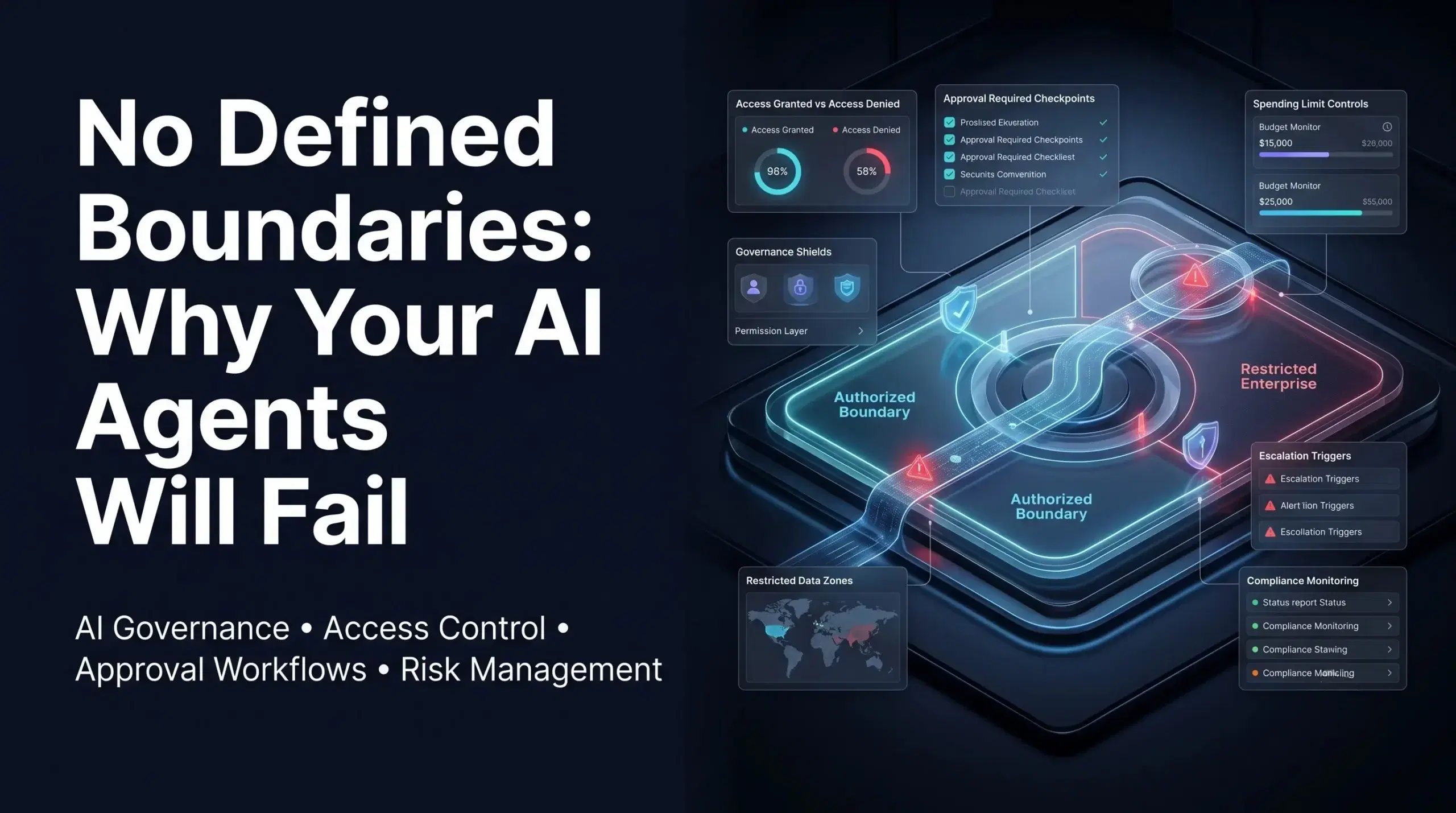
No Defined Boundaries for AI Agents: Why Enterprise AI Deployments Fail
Your AI agent just sent 4,000 emails to the wrong list. It updated every record in your CRM with incorrect pricing. It deleted a folder your legal team needed for an audit.
None of that happened because the AI malfunctioned.
It happened because nobody told the AI what it was not allowed to do.
This is sign number 13 of the 15 signs your organization is not ready for AI agents: no defined boundaries. And if you are a CEO, CTO, or senior leader evaluating AI deployment right now, this one deserves more attention than almost anything else on that list.
Unrestricted AI agents are not just a technical risk. They are a governance risk, a compliance risk, and a business continuity risk.
When an autonomous system can act without limits, every mistake it makes scales instantly across your entire operation.
Here is the thing most vendors will not tell you: the most dangerous thing about a powerful AI agent is not that it will fail to perform. It is that it will perform extremely well, in completely the wrong direction.
What “No Defined Boundaries” Actually Means in an AI Agent Context
When we say an AI agent has no defined boundaries, we are not talking about the agent going rogue in some science fiction sense.
We are talking about something far more common and far more damaging: an agent that has been given a goal without being given the guardrails that define how far it can go to achieve that goal.
Think of it this way. You hire a new employee and tell them to “improve customer response times.” Without further instruction, they might reasonably decide to disable the approval layer on all outbound communications, auto-close support tickets after 10 minutes, and send bulk updates to every customer who has an open case.
Technically, response times improved.
Practically, your customer trust just collapsed.
AI agents operate on the same logic. They optimize for the objective they have been given. If you have not told the agent what it cannot do, it will find the most efficient path to its goal, and that path may cross every boundary your business depends on.
AI agent scope limits are not a feature you add later. They are a foundational requirement.
Without them, you do not have an AI agent. You have a liability engine running at machine speed.
Here is what undefined boundaries look like in practice:
- An agent with access to your email system sends automated responses to clients without a review step.
- An agent managing inventory places purchase orders beyond budget thresholds because no spending cap was defined.
- An agent analyzing HR data accesses employee records outside its designated scope because nobody restricted which data sets it could query.
These scenarios are not far from reality. They are the predictable outcome of deploying AI agents without establishing what they are and are not allowed to do.
Why Leaders Underestimate This Risk Until It Is Too Late
Here is the pattern we see repeatedly with enterprise AI deployments: leadership approves the use case, the technical team deploys the agent, and the boundary question gets deferred to a later phase.
That later phase often never comes.
Part of the reason is how AI agents are sold and marketed. The emphasis is always on capability: what the agent can do, how fast it can act, how much it can automate.
The conversation about what the agent should never do gets far less attention.
The other reason is that the risk is invisible until it becomes a crisis. An agent operating without defined limits will often perform well in early testing, precisely because early testing environments are controlled.
The moment you scale to production, with real data, real customers, and real stakes, the absence of boundaries becomes catastrophic.
We have covered the downstream effects of poor governance in our earlier posts on no clear AI ownership in organizations and no metrics for AI performance. Undefined boundaries are what make both of those problems impossible to fix after the fact.
Leadership teams tend to think of AI risk in terms of the AI failing to deliver results.
The more sophisticated and more urgent risk is the AI delivering results that were never authorized.
AI agent governance cannot be an afterthought. It has to be the first conversation, not the last.
The Five Boundaries Every Enterprise AI Agent Needs Before Deployment
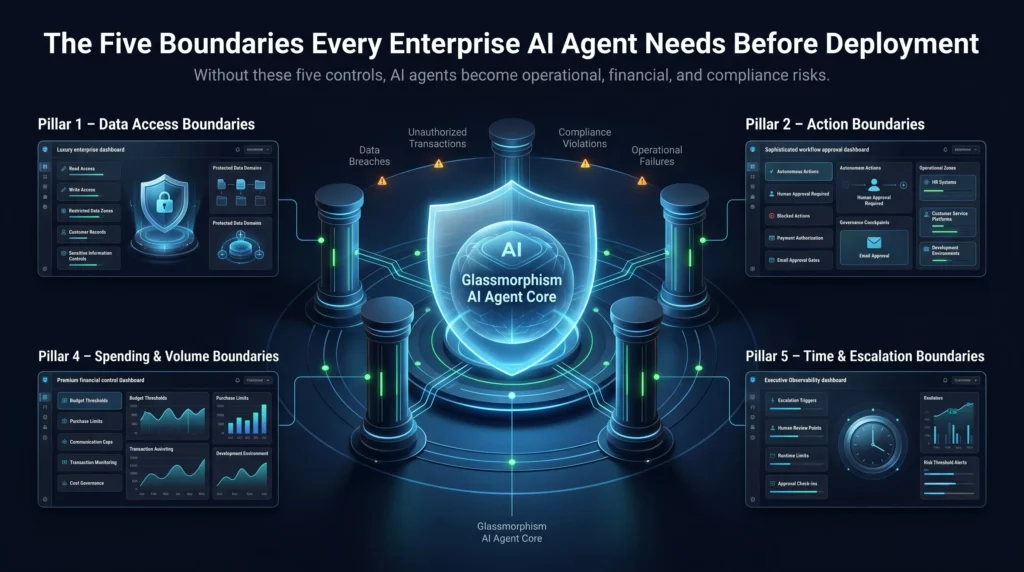
If your organization is deploying or evaluating AI agents, these are the five boundary categories your governance framework must address before a single agent goes live.
1. Data Access Boundaries
The first question to answer is: what data can the agent read, what can it write, and what is completely off limits?
An agent with read access to customer records should not have write access unless that specific action is part of its authorized function.
Data access boundaries prevent agents from inadvertently exposing, corrupting, or leaking sensitive information.
We have written in detail about how poor data quality undermines AI agent performance, but even clean data becomes a liability when accessed by an agent without scope restrictions.
2. Action Boundaries
Not every action an agent can perform should be performed autonomously.
Some tasks need human approval before execution. An agent that can send emails, initiate payments, update records, and trigger workflows needs clear action tiers.
Some actions can be fully autonomous. Others must trigger a review, and some should be permanently blocked.
This connects directly to the approval and review layer your AI deployment needs. Without action boundaries, there is nothing for that review layer to enforce.
3. Scope Boundaries
Scope boundaries answer a simple but critical question: where does this agent belong, and where does it not?
An HR agent should not have the ability to reach into financial systems. Likewise, a customer service agent should not have access to internal development environments.
Scope boundaries define the operational territory the agent is allowed to occupy.
4. Spending and Volume Boundaries
If the agent can trigger transactions, orders, or communications at scale, what are the caps?
A purchasing agent without spending limits can drain a budget in hours. A marketing agent without volume caps can trigger spam filters, damage email deliverability, or violate communications regulations.
5. Time and Escalation Boundaries
When should the agent stop and wait for a human?
How long should it operate autonomously before requiring a check-in? What triggers escalation?
Time boundaries prevent agents from compounding errors over extended periods before anyone notices something has gone wrong.
Unrestricted AI Actions and the Compliance Exposure Most Leaders Miss
There is a regulatory dimension to undefined AI agent boundaries that deserves direct attention, especially for organizations in healthcare, financial services, and any sector handling personal data.
When an AI agent takes an action that violates a data handling requirement, the organization is still responsible.
This includes actions such as accessing records it should not access, sending communications that breach consent rules, or retaining data beyond permitted periods.
Regulators are unlikely to accept “the AI acted on its own” as a sufficient explanation. Autonomous systems that operate under your organizational umbrella are still part of your operational responsibility.
If those systems did not have defined boundaries, that gap in governance can create serious audit, legal, and reputational exposure.
Security built only for humans is a related problem we have covered in depth. Traditional access controls assume a human is making decisions.
AI agents act at a speed and scale that completely outpaces human-designed security models. Boundary definitions are how you extend governance to autonomous behavior.
In sectors like healthcare and pharma, where we work extensively at Ysquare Technology, this compliance exposure is not theoretical. It is the difference between a successful deployment and a regulatory investigation.
How Undefined Boundaries Connect to the Other 14 Readiness Gaps
No defined boundaries does not exist in isolation. It is the consequence and the amplifier of several other readiness gaps your organization may already be experiencing.
If your knowledge is scattered across multiple tools and teams, as we covered in our post on scattered knowledge silently sabotaging AI agents, an agent without boundaries will query all of it, including the parts it should never touch.
The same challenge applies to documentation that does not match reality: if the agent is navigating processes that exist only in people’s heads, it has no map and no limits.
When there are multiple versions of truth in your data environment, an agent without scope restrictions will pull from all of them and produce outputs that are confidently wrong.
When real-time data access is missing, an agent trying to make decisions without boundaries compounds outdated information into operational errors.
Leadership not driving AI adoption is also directly connected here.
Boundary setting is a leadership decision, not a technical one. It requires executives to define what the organization is and is not willing to authorize AI to do.
When leaders are not actively involved in AI governance, boundary definitions get left to whoever deployed the agent, and they rarely have the authority or context to make those calls correctly.
The Pulse articles we have published on real-time data access, documentation failures, and scattered knowledge each point to the same underlying gap: organizations are deploying AI capability without deploying the governance that makes that capability safe.
Undefined boundaries are what happens when you stack all of those gaps together and hand the result a set of automation tools.
What Responsible AI Agent Deployment Actually Looks Like
The good news is that defining AI agent boundaries is not technically complex.
The challenge is organizational.
It requires the right people to be in the room, asking the right questions, before deployment begins.
Here is the practical framework we recommend:
1. Start with an authorization matrix.
For every function the agent will perform, define whether it is fully autonomous, requires notification, or requires approval. Build this matrix with input from legal, compliance, operations, and the technical team, not just the team deploying the agent.
2. Define exclusions explicitly.
Most governance frameworks focus on what the agent should do. Equally important is a written list of what it must never do. These exclusions should be documented, version-controlled, and reviewed regularly.
3. Build in hard limits at the system level.
Do not rely on prompt instructions alone to enforce boundaries. Hard technical limits, including spending caps, volume restrictions, and data access controls, should be enforced at the infrastructure level, not the instruction level.
4. Test for boundary violations before launch.
Before any agent goes live, run scenarios specifically designed to push the agent toward its limits. See what it does when it reaches a boundary. See what it does when someone tries to instruct it to cross one.
5. Assign ownership of the boundary framework.
Someone specific, a role not a committee, needs to be accountable for maintaining and updating the boundary definitions as the agent’s scope evolves. This connects directly to the no clear AI ownership problem we have documented across enterprise deployments.
The Real Question Every CEO and CTO Should Be Asking
Here is the real question most enterprise AI evaluations skip entirely:
“What is the worst thing our AI agent could do if it performed exactly as designed but in the wrong context?”
If you cannot answer that question, you are not ready to deploy.
The ability to define boundaries is not a sign of distrust in AI technology. It is the mark of organizational maturity.
The companies that get the most from AI agents are not the ones that gave those agents the most freedom. They are the ones that built the clearest operational contracts, defining what the agent is responsible for and what it is explicitly not.
AI agents are not magic. They are powerful tools operating within an organizational system.
Every powerful tool needs defined operating parameters.
A scalpel is extraordinary in a surgeon’s hand and dangerous without one. An AI agent without boundaries is no different.
The organizations we see deploying AI successfully, in healthcare systems, enterprise software, and large-scale operations, all share one thing: they treated boundary definition as a first-order requirement, not an afterthought.
They answered the hard governance questions before they wrote a single line of deployment code.
That is the bar your AI agent readiness framework needs to clear.
Conclusion
No defined boundaries for AI agents is not a technical problem with a technical solution.
It is a governance problem that requires organizational leadership to solve.
If you are assessing your organization’s readiness to deploy AI agents, boundary definition should be one of the first items on your evaluation checklist.
Not because you distrust the technology, but because the technology will do exactly what it is capable of doing. Without limits, that capability can eventually create consequences your business cannot absorb.
The 15 signs of AI agent unreadiness are not independent problems. They reinforce each other.
But no defined boundaries is the one that turns all the others into active risks.
Fix this one, and you make every other gap manageable. Leave it unaddressed, and every other AI investment you make becomes harder to protect.
At Ysquare Technology, we work with healthcare organizations, enterprise technology companies, and operations-driven businesses to build AI agent governance frameworks that are practical, auditable, and built to scale.
If your organization is preparing to deploy AI agents, Ysquare Technology can help you define practical governance boundaries, approval workflows, secure access controls, and scalable operating models before deployment.
Read More
Ysquare Technology
15/06/2026
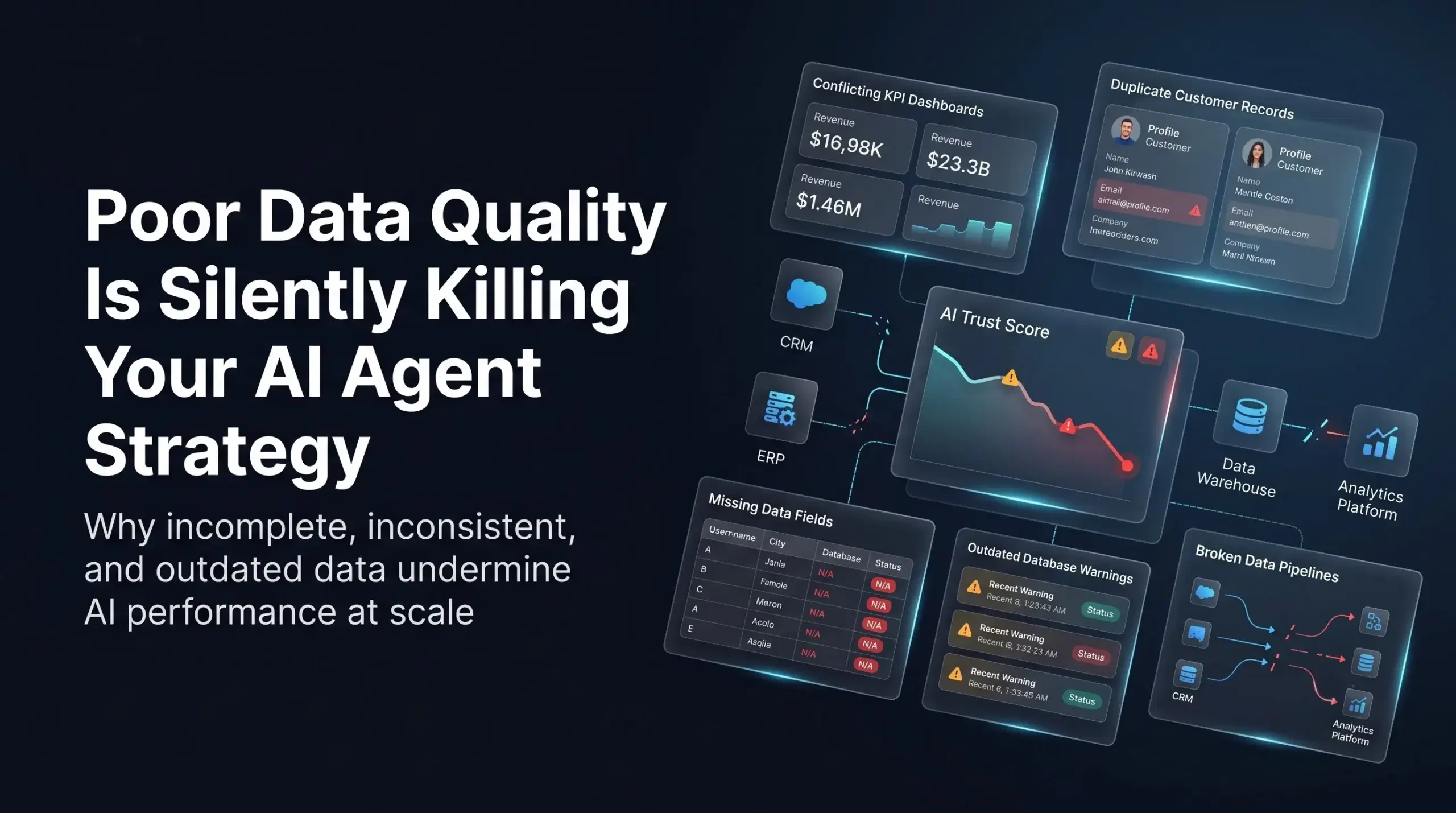
Poor Data Quality Is Silently Killing Your AI Agent Strategy
Your AI agents are not the problem. Your data is.
Most organizations investing heavily in AI automation hit the same invisible wall. The tools are purchased, the agents are deployed, and the dashboards look impressive. But the outputs are wrong. Decisions are off. The team loses trust in the system within weeks.
Here is the real reason: poor data quality is quietly undermining everything your AI agents are supposed to do. It is not a technology failure. It is a data failure that was always there, just waiting for an autonomous system to expose it at scale.
This is the twelfth sign in the AI Agent Readiness Series, which examines fifteen critical gaps that prevent organizations from running AI agents reliably. If your AI agents are producing unreliable outputs, inconsistent results, or decisions that nobody trusts, data quality is almost certainly the root cause. Let us get into exactly why, and what you can do about it.
What Poor Data Quality Actually Means for AI Agents
Most executives interpret data quality as a technical concern they delegate to their data teams. That is understandable, but it misses the real business exposure.
For AI agents, data quality is not just about clean spreadsheets or well-labelled databases. It covers every piece of information an agent reads, references, or acts on when executing a task. That means CRM records with inconsistent customer names, ERP entries with missing cost codes, product catalogues with outdated pricing, and patient records with duplicate entries across systems.
AI agents do not verify data before they use it. They cannot pause and say this looks wrong. They process what they are given and produce outputs accordingly. When the input is corrupted, incomplete, or contradictory, the agent delivers garbage outputs at the speed of automation.
The old principle applies perfectly here: garbage in equals garbage out. The difference is that a human analyst might catch an anomaly before it becomes a decision. An AI agent running at scale will not.
Here is what that looks like in practice. An agent managing procurement approvals reads outdated supplier pricing data and commits to orders at rates that are no longer valid. An agent handling patient scheduling pulls from a record that has not been updated since a system migration, and books appointments for inactive patients. An agent producing financial summaries aggregates figures from two databases that use different fiscal calendar definitions.
None of these failures are caused by the AI being wrong. They are caused by the data being wrong. Understanding this distinction is the first step toward fixing it.
The Three Most Dangerous Forms of Poor Data Quality in AI Deployments
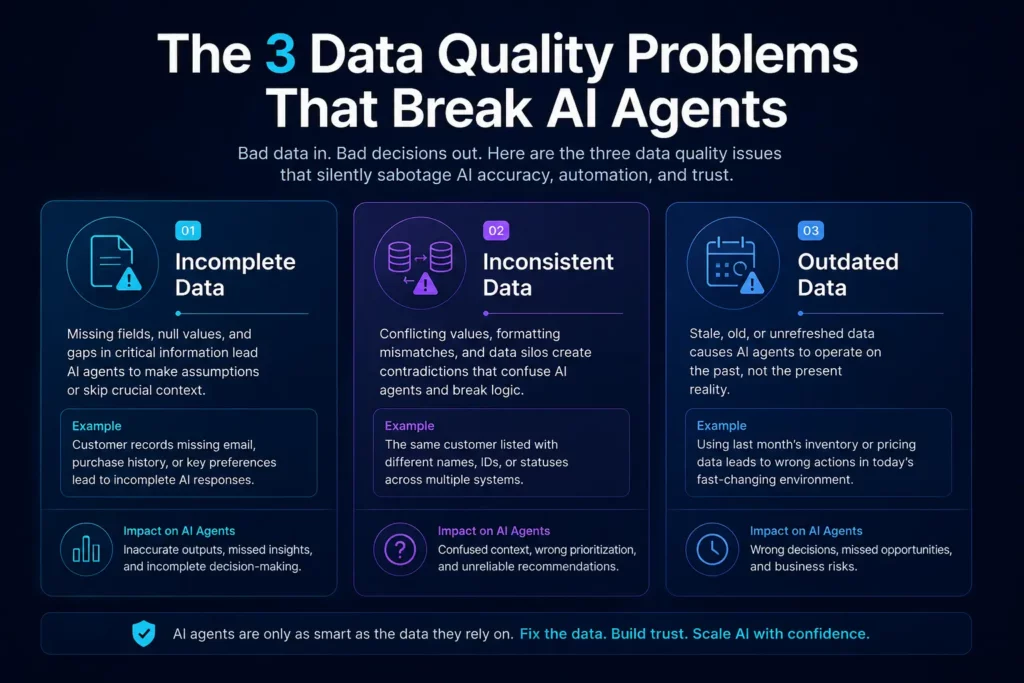
Not all data problems carry equal risk. When it comes to AI agents specifically, three patterns cause the most downstream damage.
Incomplete Data
Incomplete data means fields that should contain information are empty, null, or populated with placeholder values. For a human reading a report, an empty field is a flag to follow up. For an AI agent, it is often a signal to skip that record, make an assumption, or produce an output that excludes a critical variable.
In healthcare, incomplete patient records can lead an AI agent to generate clinical summaries that miss relevant diagnoses. In finance, incomplete transaction logs can cause automated reconciliation agents to produce reports that regulators will immediately question. The agent does not know what it does not know.
If your organization struggles with fragmented knowledge living across tools and teams, you already have a data completeness problem. Understanding how scattered knowledge silently sabotages AI performance is directly connected to why incomplete data causes agent failures.
Inconsistent Data
Inconsistency is more dangerous than incompleteness because it is harder to detect. Inconsistent data is present but contradictory. The same customer appears with three different company names across CRM, billing, and support systems. The same product has different SKU codes in two warehouses. The same employee has a start date in HR that does not match what is in payroll.
AI agents that draw from multiple data sources will encounter these contradictions and resolve them in ways that are technically logical but contextually wrong. The agent sees two valid records and chooses one. Nobody flags the discrepancy. The output looks clean. The decision is still wrong.
This is closely linked to the challenge of multiple versions of truth across enterprise systems. Organizations that have not resolved that problem at the data architecture level are not ready to run AI agents safely.
Outdated Data
An AI agent making decisions based on information that was accurate six months ago is making decisions in the past. Outdated data creates a time-lag between reality and what the agent believes to be true.
This is particularly acute in industries where conditions change quickly. Market data, inventory levels, regulatory requirements, contract terms, and customer preferences all shift. An agent relying on stale records will produce recommendations that are confidently wrong.
The connection between real-time data access and AI agent reliability deserves its own dedicated analysis, and it does. Organizations building AI agents without live data pipelines are setting themselves up for this exact failure mode.
Why Poor Data Quality Scales the Problem Instead of Containing It
Here is what makes this genuinely dangerous for leadership to understand. Human teams and poor data quality exist in a kind of friction that slows the damage. A sales manager spots that the customer record looks off. A finance analyst questions the number before it goes into the report. Manual verification acts as a natural buffer.
AI agents remove that buffer. When you automate a process that runs on poor data, you do not just replicate the existing error rate. You accelerate it. What was previously one wrong decision per week becomes one hundred wrong decisions per day, all consistent, all automated, and all downstream from the same corrupted source.
Scale is the thing that makes poor data quality existentially risky for AI deployments. Organizations that have not established an approval and review layer before AI-generated outputs reach decision-makers are particularly exposed. Automation without oversight turns a manageable data problem into a systemic one.
The damage compounds further when there are no metrics in place to measure AI performance. If you are not tracking the accuracy of your agent outputs against known baselines, poor data quality will go undetected for months. By the time someone notices, the contamination has spread across multiple systems, reports, and business decisions.
How to Assess Your Organization’s Data Quality Readiness Before Deploying AI Agents
Most data quality frameworks are designed for reporting and compliance. They are not built for the speed and autonomy of AI agent operations. Before you deploy any AI agent in a live business process, you need to run a different kind of assessment.
Start with your primary data sources. For every data asset an agent will access, ask four questions:
Who owns this data and is responsible for keeping it accurate? Organizations without clear AI ownership tend to have the same gap in data ownership. Nobody claims responsibility, so nobody maintains it.
How often is this data validated against a known source of truth? If the answer is quarterly or during audits, that cadence is too slow for autonomous agent operations.
What happens when a record is missing or contradictory? Is there a defined fallback, or does the system just make a choice? AI agents need explicit rules for handling data exceptions.
Is this data sourced from a live system or a static export? Static exports introduce version drift. Agents reading from exports are almost always working with data that is already partially outdated.
The answers to these four questions will tell you more about your AI readiness than any vendor briefing. Organizations that cannot answer them confidently are not in a position to deploy AI agents in production.
Building a Data Quality Foundation That AI Agents Can Actually Trust
Fixing data quality for AI operations is not a one-time cleanse. It is an ongoing architecture decision. Here is where to start.
Establish a single source of truth for every data domain that an AI agent will touch. This does not mean consolidating all data into one system. It means defining which system is authoritative for each data type, and making sure agents only read from that system. The documentation of that architecture matters just as much as the architecture itself. Undocumented workflows and unofficial data sources are how poor quality enters the pipeline quietly.
Build automated data validation into every pipeline that feeds an agent. This means schema checks, completeness checks, and anomaly detection that runs before data is served to the agent. Agents should never receive raw, unvalidated input from operational systems.
Instrument your agents to flag data-related failures explicitly. When an agent encounters a missing field, a value outside expected parameters, or a conflict between two sources, that event should be logged, categorized, and reviewed by a human. This is not just good practice. It is how you build the feedback loop that improves data quality over time.
Assign ownership. Every data domain feeding an AI agent needs a named person or team who is accountable for its accuracy. Without ownership, improvement discussions go nowhere. When something breaks, everyone points elsewhere.
Leadership driving AI adoption has to include leadership driving data ownership. If the CTO understands the data quality imperative but business unit heads are not committed to maintaining their data domains, the technical fixes will degrade quickly.
What Good Data Quality Enables Your AI Agents to Do
It is worth stepping back and making the positive case, because data quality conversations often stay stuck in risk and remediation.
When your AI agents operate on accurate, complete, and current data, their outputs become something your organization can actually rely on. Agents can close the loop between action and outcome. They can identify patterns that human analysts would miss. They can escalate anomalies correctly. They can produce recommendations that hold up to scrutiny.
That is the version of AI that most organizations are sold when they begin their journey. The reason they do not reach it is almost always data quality. The technology is capable. The data infrastructure is not ready.
Organizations that do invest in data quality before deployment see compounding returns. Every agent that operates reliably builds organizational confidence. That confidence makes the next deployment easier to approve, easier to scale, and easier to integrate into core business processes.
For CEOs and CTOs, the business case for data quality investment is not abstract. It is the difference between AI that generates demonstrable ROI and AI that generates expensive noise.
Poor Data Quality in the Context of the AI Agent Readiness Framework
This article covers sign twelve of the fifteen signs that your organization is not ready for AI agents. But it does not exist in isolation.
Poor data quality is often the downstream consequence of several other readiness gaps. When knowledge is scattered across teams and tools, data completeness suffers. When documentation does not reflect how work actually happens, the data that powers automated processes is built on false assumptions. When no one owns AI outcomes at the organizational level, data domains go unmaintained because there is no accountability structure.
Addressing poor data quality in isolation, without also examining the systemic gaps that produce it, is a short-term fix. If you have not yet worked through the earlier articles in the series, the ones covering scattered knowledge, documentation gaps, and real-time data access are the most directly relevant to what you have read here.
Also relevant: organizations that have not addressed security models built only for human users are often running agents that access data they should not, which compounds every data quality issue described in this article.
You can also review the original LinkedIn post on poor data quality quietly killing your AI agent strategy for additional context.
The Real Cost of Ignoring Data Quality in AI Deployments
Poor data quality is not a problem you discover after deploying AI agents. By that point, the damage is already compounding.
The organizations that succeed with AI at scale are the ones that treat data quality as a foundational requirement, not an afterthought. They assess their data before deployment. They build validation into their pipelines. They assign ownership. They measure accuracy and iterate on it.
The good news is that fixing data quality is entirely within your control. It does not require new technology. It requires commitment, ownership, and a clear process.
If you want to know where your organization stands across all fifteen readiness signs, start working through the AI Agent Readiness Series. Ysquare Technology helps enterprises identify and close these gaps before they become production failures. Reach out to the team on LinkedIn to start the conversation.
Read More
Ysquare Technology
12/06/2026